A broker sits down at the end of the week, checks the pipeline, and sees the same problem again. Plenty of small business owners need capital, but very few respond well to generic outreach, cold calls, or ad-heavy pitches. Most have already talked to a bank, filled out paperwork, waited too long, and walked away frustrated.
That frustration is where smart marketing to small business owners starts. The broker who understands the emotional side of funding doesn't sound like another salesperson. The broker sounds like a guide who knows what to do next, how to set expectations, and how to move a file forward without adding pressure.
Table of Contents
- The Hidden Opportunity in Small Business Lending
- Understand the Modern Small Business Owner Mindset
- Your High-ROI Marketing Channel Matrix
- Crafting Messages That Convert Not Annoy
- The Automated Lead Generation Funnel Blueprint
- How to Build a No Cold Call Referral Engine
The Hidden Opportunity in Small Business Lending
A business owner gets turned down by a bank. On paper, that looks like a dead lead. In practice, it's often the start of a better conversation.
Traditional lenders reject a large share of small business borrowers, and alternative lending keeps expanding because that gap hasn't gone away. The global alternative lending market is projected to reach USD 535.4 billion by 2025, growing annually at 14.4%, and is expected to expand to USD 884.1 billion by 2029, according to this alternative lending market projection. That scale matters because it shows this isn't a side niche. It's a real industry with room for brokers who know how to solve funding problems.
For aspiring brokers, this creates a practical business model. A broker doesn't need to be the lender, hold capital, or build a branch office. The work is matching business owners with funding options through alternative lenders, then earning commissions when deals fund. Business loan brokers typically earn $1,000 to $15,000 per funded deal, which is why many people build this into a remote business with low overhead and recurring referral relationships.
Where most people miss the opening
A lot of new brokers think lead generation starts with volume. More calls. More ads. More messages. That usually produces low-trust conversations.
A better approach starts with timing and context. Owners who are actively seeking capital are easier to help than owners who haven't felt the problem yet. That's why prospecting around funding intent matters. Resources like this guide to finding funded companies can sharpen how a broker identifies businesses already operating in an active capital environment, which helps with targeting and messaging.
Practical rule: The broker who reaches the owner right after confusion starts often wins the relationship before pricing becomes the main issue.
There's also a large startup segment that needs guidance before a bank relationship ever becomes useful. Brokers serving that audience need a clear intake process, realistic expectations, and the right lender fit. Content such as small business funding for startups becomes useful because it frames the conversation around options rather than rejection.
Why this business model fits uncertain economies
When markets tighten, owners still need working capital, equipment financing, short-term liquidity, and solutions outside the bank channel. That demand doesn't disappear. It shifts.
That's why marketing to small business owners in lending works best when it focuses on access, clarity, and trust. The broker isn't selling money. The broker is reducing confusion at the moment the owner feels boxed in.
Understand the Modern Small Business Owner Mindset
The fastest way to lose a small business owner is to treat a funding conversation like a lead form. Owners who come into the alternative lending market often carry frustration from a prior denial, a stalled approval, or a process that made them feel too small to matter.

A key reality gets ignored in most generic marketing advice. Banks decline 75% of small business loan applications, which creates an underserved segment of owners who feel filtered out. Effective outreach validates that struggle and positions the broker as a partner who restores dignity, as outlined in this analysis of underserved small business buyers.
Why bank rejection changes buyer behavior
A bank decline doesn't just create a financing problem. It changes how the owner hears every future message.
Instead of asking, "Is this offer competitive?" many owners first ask silent questions such as:
- "Is this another dead end?" They don't want another long process that ends in silence.
- "Will this person explain the options?" They want straight answers, not broad promises.
- "Am I about to get judged again?" Owners often connect denial with personal failure, even when the issue is lender fit.
- "Is this going to waste more time?" Speed matters because payroll, inventory, and cash flow don't wait.
That's why marketing to small business owners can't open with hype. It has to lower emotional resistance first.
The message has to tell the owner, "You're not disqualified from funding. You may have been in the wrong channel."
How to position the broker relationship
The broker's role is part translator, part strategist, part guide. That means the message should acknowledge the owner's situation without making the owner relive it.
A stronger positioning statement sounds like this in plain language:
| Weak positioning | Strong positioning |
|---|---|
| Fast business loans available | Funding options for businesses that didn't fit bank guidelines |
| Apply now for working capital | Review financing paths based on revenue, timing, and use of funds |
| Get approved today | Get clarity on what may still be workable and what to do next |
That shift matters because it respects the owner's intelligence. It also creates more honest conversations upfront.
Owners respond better when the broker manages expectations early, especially around timing, documents, lender fit, and likely friction points. Guidance like how to manage client expectations supports that kind of communication because it keeps the broker from overpromising just to get an application started.
The segments that matter most
Psychographics matter more than broad demographics here. Three common owner mindsets show up repeatedly:
- Recently declined and still motivated: These owners need fast clarity.
- Cautious after a bad experience: They need a calm process and clean explanations.
- Skeptical but open: They won't respond to pressure, but they will respond to competence.
A broker who speaks to those states directly will outperform one who pushes generic funding offers.
Your High-ROI Marketing Channel Matrix
Most brokers waste time by trying to be everywhere. Better results usually come from picking a short list of channels that match how owners discover and trust funding help.
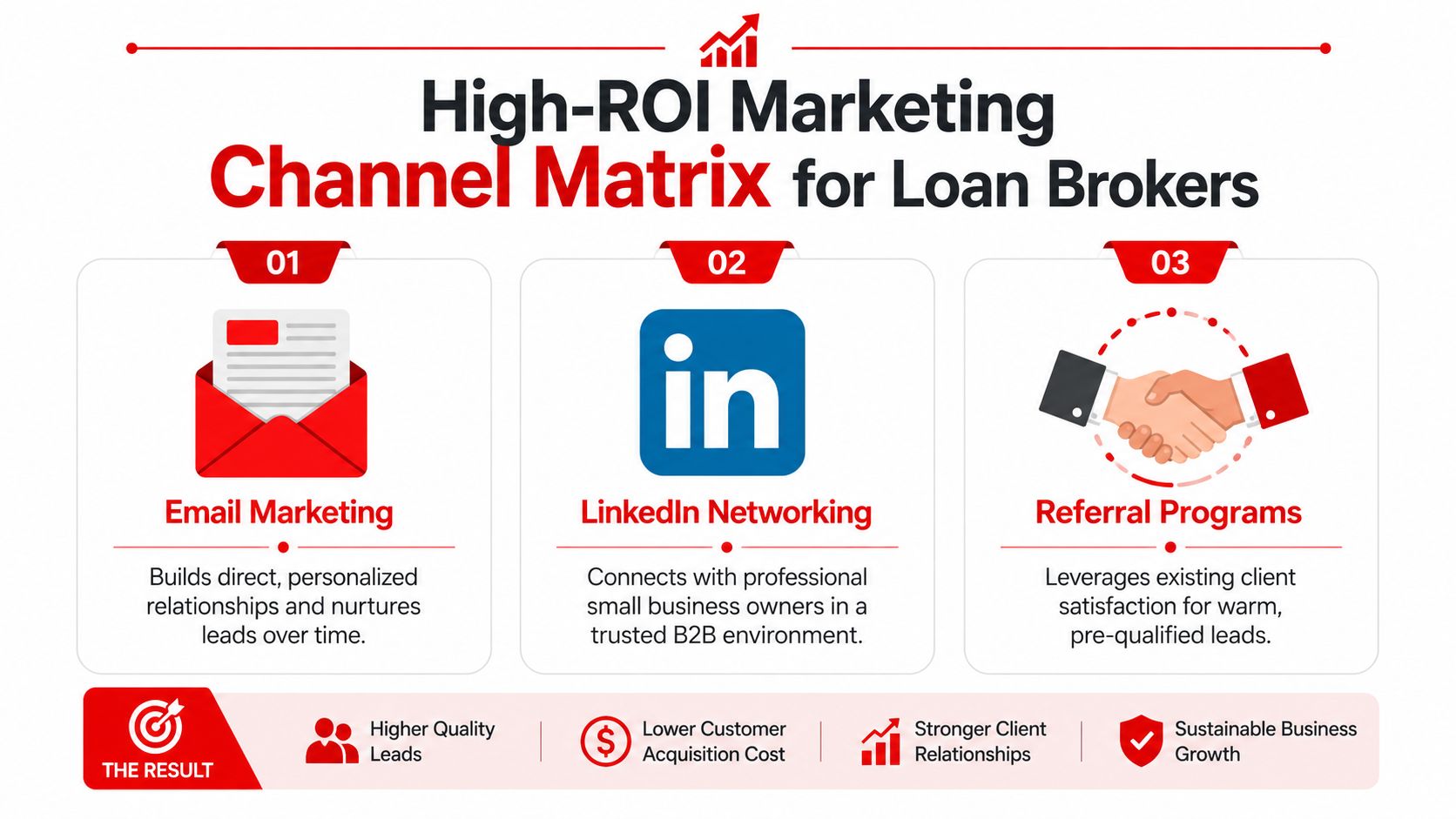
The economics point in a clear direction. Email marketing returns $36 for every $1 spent, SEO returns $22 for every $1 spent, and 96% of small businesses use social media in their strategy, according to these small business marketing channel statistics. For a broker, that doesn't mean chasing every platform. It means choosing channels that create direct access, professional trust, and consistent visibility.
Email as the core channel
Email works because it gives the broker control over timing, education, and follow-up. It also supports a longer sales cycle without forcing the owner into constant calls.
The first move isn't sending promotions. It's building a useful sequence.
- Start with a plain-language welcome email. Explain who the service is for, what kinds of scenarios may fit alternative lending, and how the review process works.
- Follow with educational emails. Cover common confusion points like revenue use, timing, documentation, and lender fit.
- Add a soft response prompt. Ask the owner to reply with the reason they sought funding in the first place.
That approach warms up skeptical leads without sounding aggressive.
LinkedIn for professional trust
LinkedIn isn't a volume game for brokers. It's a positioning channel. Owners, accountants, consultants, and service professionals tend to judge credibility quickly there.
A useful first step is simple. Tighten the profile headline and summary so they speak to business funding outcomes, not generic sales language. Then connect with local owners and adjacent professionals using short, respectful messages tied to a business issue they already understand.
A good connection note doesn't pitch. It opens a lane for future conversation.
Field note: If the first message sounds like a campaign, it gets ignored. If it sounds like context, it gets read.
Local SEO and strategic visibility
When an owner searches for funding help, local relevance still matters. A broker doesn't need a huge content library to begin. A clean site, service pages built around real financing scenarios, and a completed business profile can create early traction.
The better angle is specificity. Pages about equipment financing, working capital, startup funding, or bank-decline alternatives are more useful than broad claims about helping any business with anything.
A simple local visibility checklist looks like this:
- Create focused service pages: Each page should align to a real funding situation.
- Use local trust signals: Include geography, business type examples, and a clear consultation path.
- Publish educational articles: Answer owner questions before they speak to anyone.
- Track every inquiry in one place: Missed follow-up kills good leads.
That final point is where many solo brokers struggle. A basic system for lead stages, reminders, and nurture sequences matters more than fancy branding. Operational guidance like using a CRM system for mortgage brokers is still useful here because the underlying discipline is the same. Track every contact, every next step, and every referral source.
What deserves less attention early
Paid ads can work later, but they rarely fix weak positioning. A new broker usually gets more traction from email, trust-based networking, and local search visibility than from trying to buy attention too early.
This is also where one structured training option can help. Business Lending Blueprint teaches a no cold-calling, referral-driven model and includes practical website and marketing guidance for people building a loan brokerage from home. For a new broker, that kind of structure can shorten the learning curve. It doesn't replace execution, but it can organize it.
Crafting Messages That Convert Not Annoy
Most bad outreach fails before the owner reaches the second sentence. It sounds rushed, vague, and self-centered. The broker wants the reply. The owner wants relevance.
That mismatch is why messaging needs a hard reset.
What weak outreach sounds like
A typical weak message says something like:
Hi, we offer fast business funding with flexible options. If you need working capital, reply now for details.
Nothing in that note acknowledges the owner's context. It assumes urgency, skips trust, and asks for action before earning attention.
The same problem shows up on social posts and email campaigns. Too much promotion. Not enough education.
A better rule is the 80/20 content split. 80% educational content and 20% promotional messaging performs better because business owners show a 3.4x higher engagement rate with educational posts versus ad-heavy content on social media, according to this loan broker marketing benchmark.
What rejection-resilient messaging sounds like
Now compare the weak version to something more useful:
Many owners seek funding after a bank says no or slows the process down. That doesn't always mean the deal is dead. It may mean the request needs a different lender fit. If capital is still needed, a quick review can usually identify what options may still be workable.
That message works better for three reasons:
- It names a real situation: Bank friction or denial.
- It removes shame: The issue is fit, not failure.
- It offers a next step: Review options, not push an application.
Here's the same idea in a short LinkedIn message:
Reaching out because many small business owners get stuck after a bank process stalls. This work focuses on alternative funding paths when timing or lender guidelines become the issue. Happy to share a simple breakdown of what usually makes a file workable.
And in a follow-up email:
Subject: Still looking at funding options?
If the bank route didn't move forward, that doesn't automatically close the door. Some requests work better through lenders with different guidelines, shorter timelines, or more flexibility around use of funds. If it helps, a brief review can usually clarify whether it makes sense to proceed.
A simple content mix that earns replies
A broker's content calendar doesn't need to be complicated. It needs to be credible.
| Content type | What it does |
|---|---|
| Educational post | Explains a funding concept in plain English |
| Story-based email | Describes a common owner situation and what changed |
| Short checklist | Helps owners prepare before applying |
| Promotional CTA | Invites the owner to schedule a review |
This same principle even carries into offline outreach. For brokers using mail or leave-behind pieces with strategic partners, studying how other relationship-based industries handle educational print can help. A piece like this guide on direct mail for real estate agents is useful because it shows how concise, trust-building messaging beats cluttered promotion.
The best broker messages don't try to sound clever. They sound informed, calm, and helpful.
The Automated Lead Generation Funnel Blueprint
A solo broker doesn't need a complex funnel. A solo broker needs a system that turns attention into conversations and conversations into qualified applications without depending on daily manual outreach.
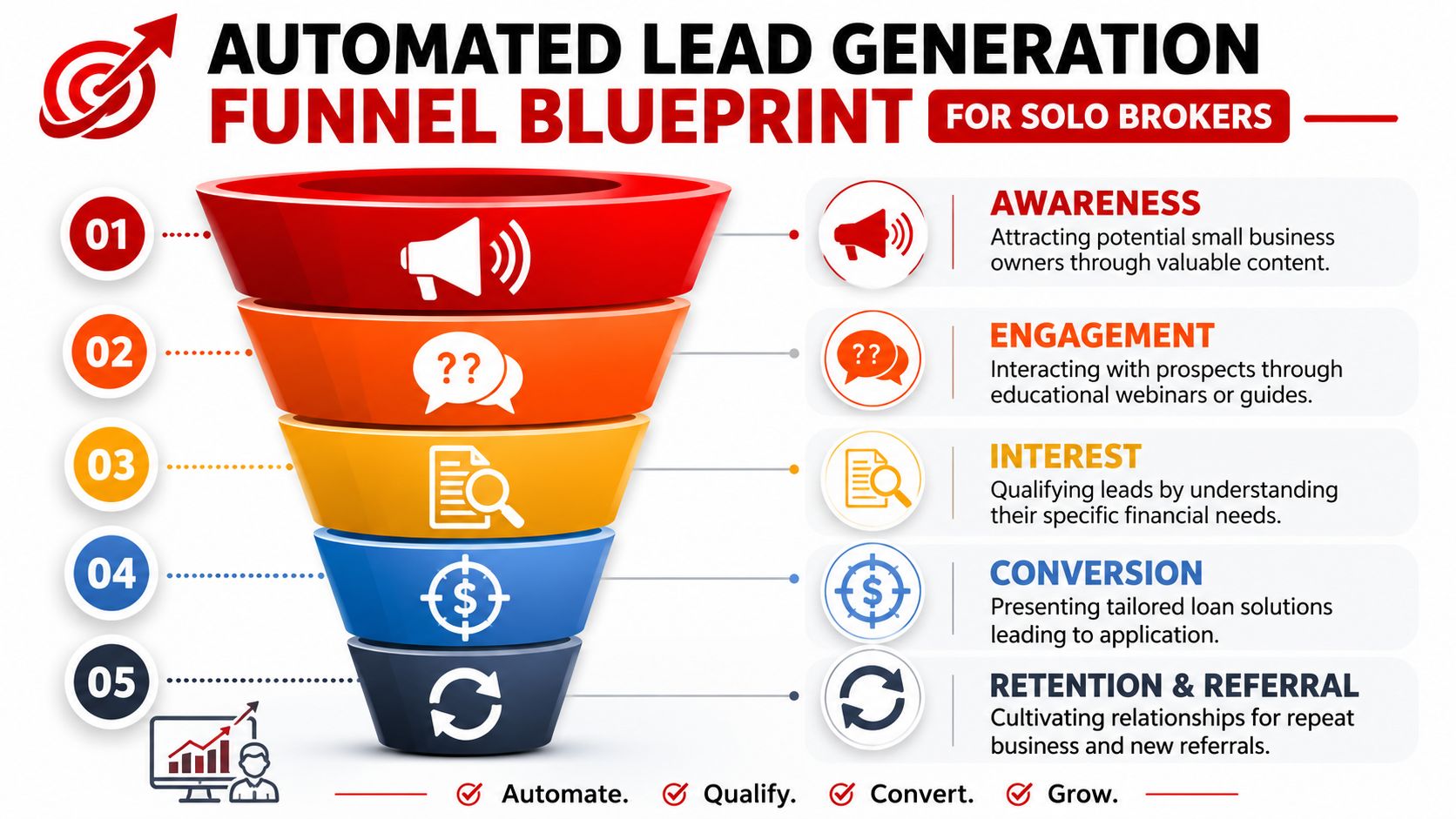
The cleanest model has three functional layers. Awareness content brings owners in. A consideration asset captures interest. A decision offer moves the right people into a strategy call.
How the funnel works in practice
A practical version looks like this:
Awareness through useful content
Publish articles, short posts, and simple explanations around common funding problems. Topics should match owner intent, such as bank declines, startup funding confusion, working capital timing, or equipment purchase scenarios.Engagement through a lead magnet or workshop
Offer a short guide, a checklist, or a webinar that helps owners assess where they stand. The point isn't to impress them. The point is to give them enough clarity to raise their hand.Interest through qualification
Once they opt in, the broker uses email follow-up to ask better questions. Why is the capital needed? How quickly? What happened with prior applications? What documents are available?Conversion through a strategy session
The call isn't a pitch session. It is a diagnosis session. The broker identifies possible fit, likely issues, and next steps.Retention through nurture and referrals
Every contact who isn't ready now still belongs in the system if the conversation was legitimate.
A lot of small operators skip stage two. That's a mistake. Without a middle step, every lead goes straight from curiosity to sales pressure.
Owners who aren't ready to apply may still be ready to learn. That group becomes future deal flow if the follow-up stays useful.
What to automate and what to keep personal
Automation should handle consistency, not relationships.
A good line to draw looks like this:
- Automate repetitive education: Welcome emails, FAQ sequences, document prep guidance, and reminders.
- Personalize qualification: Replies, reviews of the owner's situation, and strategy calls.
- Standardize handoffs: Every lead should move through the same basic pipeline stages.
- Keep referral follow-up warm: Referral sources should never feel like they entered a machine.
For brokers building this out, frameworks around nurture and follow-up from articles like Stamina on revenue automation are useful because they reinforce the value of automated consistency without removing the human layer.
The funnel is simple on purpose
Complicated funnels usually hide weak messaging. A simple funnel reveals it fast.
If awareness content gets views but no opt-ins, the topic may be too broad. If opt-ins happen but calls don't book, the consideration asset may not create enough urgency or trust. If calls book but files don't move, qualification or expectation-setting may be weak.
That feedback loop is what makes the funnel valuable. It shows where the broker needs better language, stronger targeting, or cleaner follow-up.
How to Build a No Cold Call Referral Engine
The strongest marketing to small business owners often starts after the deal funds, not before. Satisfied clients and trusted partners produce warmer introductions, cleaner conversations, and better close rates than cold outreach.
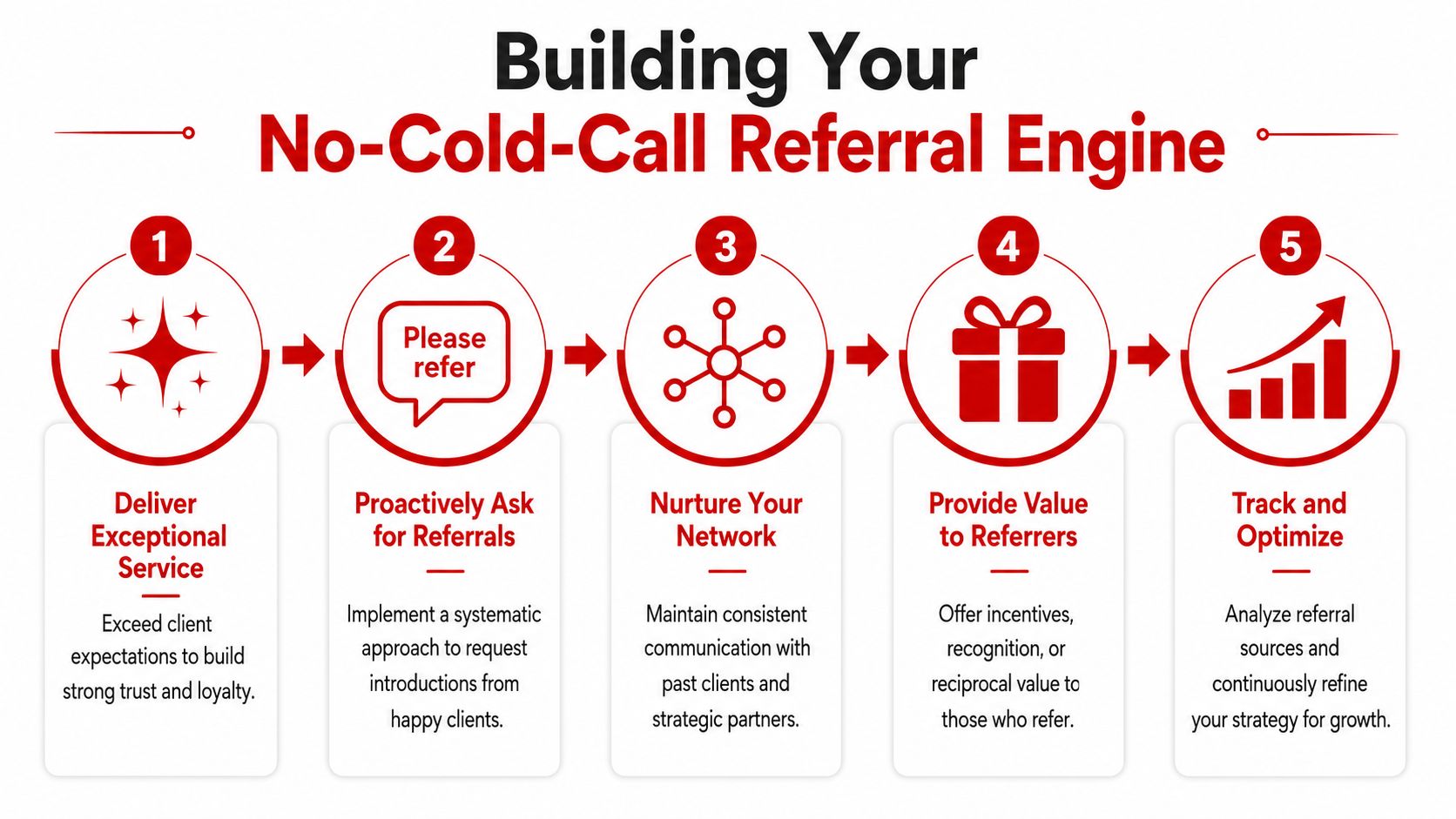
A proven sequence is already clear. A post-funding survey within 48 hours, followed by a tangible incentive that boosts referral conversion by 25%, plus a quarterly email cadence, can generate an average of 2 to 3 qualified leads per closed $50,000 loan. Referred deals also close at 18% to 24% versus 6% to 9% on cold prospects, based on this referral-based lending playbook.
The referral sequence that compounds
This process works because it matches the client's emotional timeline. Right after funding, relief is high and goodwill is strongest.
Use a sequence like this:
- Ask for feedback quickly: Send the survey within the first 48 hours.
- Request the referral directly: Don't hint. Ask clearly if they know another owner who may need funding help.
- Offer a tangible incentive: A concrete thank-you increases follow-through.
- Stay visible quarterly: Send useful updates, short case-style examples, and reminders about who the broker helps.
- Track every source: Learn which clients and partners consistently send workable introductions.
Why this model holds up in tougher markets
Cold calls depend on interruption. Referrals depend on trust. In uncertain markets, trust wins.
This model also fits the broker lifestyle many people want. It supports remote work, relationship-based growth, and a steadier flow of opportunities from past clients, CPAs, consultants, and local service professionals. Brokers who want more structured prospecting around this can sharpen their pipeline with resources on business broker leads.
A no cold call business doesn't happen by accident. It comes from doing the deal well, asking at the right time, and staying organized enough to turn one satisfied client into the next conversation.
Business Lending Blueprint teaches people how to start a profitable lending business by becoming a business loan broker, without acting as the lender. For aspiring entrepreneurs, consultants, bankers, CPAs, sales professionals, and career changers looking for a recession-resistant, home-based income opportunity, the model is straightforward. Help business owners access funding through alternative lenders, build referral relationships, and earn commissions on funded deals while working remotely with flexible overhead. To learn how the brokerage model works, watch the free training from Business Lending Blueprint or schedule a strategy session to see whether this business fits your goals.