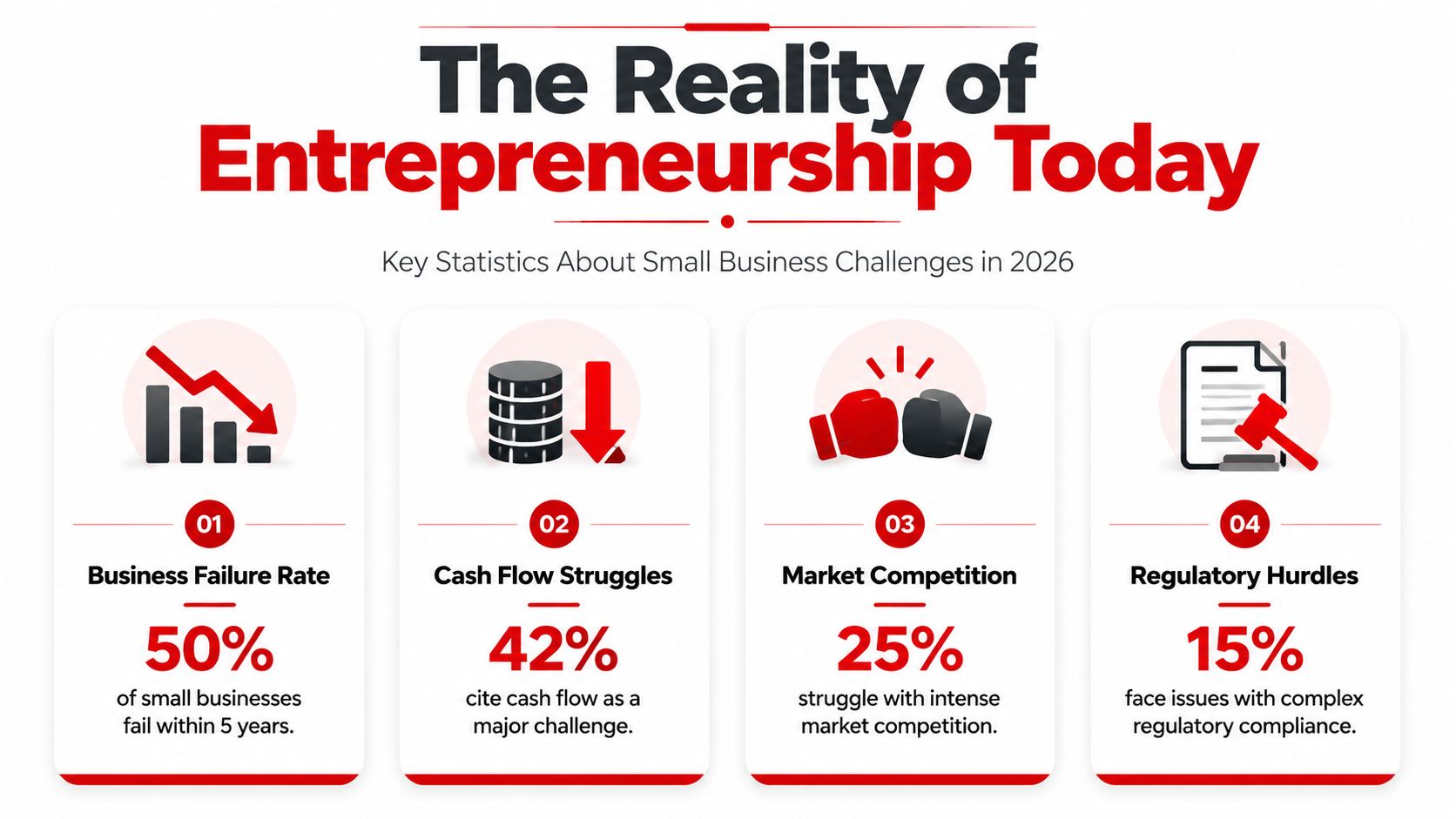
Half of U.S. small businesses collapse before reaching year five, and 20% fail in the first year according to BizReport's small business statistics. That isn't just a warning for entrepreneurs. It's a map of where demand already exists.
The usual conversation about challenges for small businesses is too soft. It treats these problems like motivation issues, branding issues, or productivity issues. Most of the time, they're capital problems wearing different clothes. Rising costs, delayed receivables, outdated systems, hiring trouble, inventory pressure, compliance friction, and stalled growth usually trace back to one hard fact: the owner doesn't have enough financial breathing room.
That creates a real opening for people who want to build a practical, home-based business. An independent business loan broker doesn't need to invent demand. Small business owners already need funding. The broker's job is to identify the pain, match it to the right financing path through alternative lenders, and become a valuable referral partner in the process.
Table of Contents
- The Reality of Entrepreneurship Today
- The Core Challenge Navigating the Cash Flow Crisis
- Beyond Funding Operational and Growth Hurdles
- The Vicious Cycle of Small Business Challenges
- The Untapped Opportunity Becoming a Business Loan Broker
- Your Blueprint for a Recession-Resistant Business
- Take the First Step to Your New Career Today
The Reality of Entrepreneurship Today
About one in five small business owners now point to inflation and operating costs as their biggest problem. That pressure shows up everywhere at once. Payroll costs more. Inventory costs more. Rent, shipping, software, and repairs all pull cash out of the business faster than owners expect.
Entrepreneurship still attracts ambitious people. It also exposes weak financial management fast. A business can have customers, solid reviews, and steady demand, then still get squeezed because expenses rise before revenue catches up.
What owners are up against
Small business strain rarely starts with one dramatic mistake. It builds through a series of predictable pressures that create financing demand.
- Higher operating costs: Owners spend more just to hold their current position.
- Thin margin for error: One slow month, one delayed payment, or one surprise bill can force hard choices.
- Late financing decisions: Owners often wait until pressure is severe before looking for capital.
- Shorter decision runway: Once cash tightens, they stop planning and start reacting.
Practical rule: Small businesses usually break down when expenses, timing, and access to capital stop lining up.
That is exactly why this market creates such a clear opening for an independent business loan broker. These problems are common, urgent, and finance-driven. If you can identify the pressure early and match it to the right funding option, you are not selling money. You are solving a business survival problem.
Consider how this plays out in the field. A contractor lands work but needs payroll before the client pays. A retailer needs stock before peak season. A service firm is profitable but gets trapped by slow receivables and may need options like invoice factoring for small businesses to keep operations steady. Each case is a financing problem hiding inside an operating problem.
That is the opportunity. The broad challenges facing small businesses are not just warnings for owners. They are recurring deal flow for a broker who knows how to spot distress, ask the right questions, and place funding before the situation turns into a crisis.
The Core Challenge Navigating the Cash Flow Crisis
The most dangerous lie in small business is that profit on paper means the company is fine. It doesn't.
A business can show demand, collect signed contracts, and still run straight into a wall if cash isn't available when bills are due. That's why cash flow is the issue that deserves the most attention from both owners and anyone thinking about becoming a broker.
Why cash flow kills businesses first
Cash flow management is the single biggest failure point. 82% of failed businesses cite cash flow management as the primary cause of closure, while 42% fail due to lack of market demand, according to Whop's roundup of small business statistics. That gap matters. It means many businesses don't die because no one wants the product. They die because the money doesn't move fast enough.
That shows up in predictable ways:
- Payroll pressure: The owner has customers, but receivables haven't landed yet.
- Inventory gaps: The business can't restock fast enough to meet demand.
- Vendor strain: Suppliers tighten terms because payments are late.
- Missed growth windows: The company turns down good opportunities because it can't fund fulfillment.
Businesses rarely say, "cash flow is collapsing." They say, "customers are paying slow," "payroll is tight," or "there's no room to buy inventory."
What a broker should learn to spot
A future business loan broker should listen for symptoms, not labels. Most owners won't diagnose the issue correctly. They'll describe the pain in operational language.
A few examples:
| Warning sign | What it usually means |
|---|---|
| Owner uses personal funds to cover expenses | The business lacks working capital |
| Growth creates stress instead of relief | Revenue timing is broken |
| Large invoices create bottlenecks | The business may need a faster liquidity solution |
| Constant vendor juggling | Payables are outpacing collections |
When the problem is delayed receivables, a funding product tied to invoices can make more sense than a generic loan. A broker who understands options such as invoice factoring for small businesses can speak to the actual problem instead of pushing the wrong solution.
Why this is a business opportunity
Traditional lending doesn't always move at the speed small business owners need. That leaves a wide gap between urgency and approval.
A broker fills that gap by doing three things well:
- Diagnosing the fundamental need
- Matching the business to an appropriate funding path
- Managing the process so the owner doesn't waste time
That isn't a clerical role. It's consultative work. The broker who can translate operational stress into financing strategy becomes valuable fast.
Beyond Funding Operational and Growth Hurdles
Most owners describe their pain as a marketing problem, a staffing problem, or a systems problem. Often, that's only half true. The deeper issue is that they can't afford the fix.
Technology is a clear example. Approximately 90% of small business owners say maintaining and upgrading technology is their biggest challenge, and only 46% feel their budget gives them access to the same tools as larger enterprises, according to Tek Efficient's review of SMB tech constraints. That gap has consequences. Businesses with weak systems move slower, track less, and make worse decisions.
Technology, marketing, and staffing are linked
A small company without capital usually runs on patched-together processes. The CRM doesn't talk to billing. Inventory tracking is inconsistent. Reporting is late. The owner keeps too much in their head.
That same business then struggles to market effectively. Customer acquisition gets reactive because there isn't enough cash to build consistent outreach, tighten follow-up, or test channels properly. For owners trying to unlock growth through lead generation, funding often determines whether the plan gets executed or stays stuck as an idea.
Overhead exposes the real problem
Some owners think they need more sales when they need better cost control and better capital structure. A broker who understands overhead can ask better questions.
- Fixed expenses: Rent, software, admin payroll, insurance
- Variable strain: Materials, subcontractors, shipping, sales costs
- Invisible drag: Redundant tools, underused subscriptions, inefficient manual work
A clear breakdown of how to calculate overhead cost helps identify whether the business is undercapitalized, overpriced, or disorganized.
The broker who understands operations doesn't just chase applications. That broker earns trust by showing owners why the cash keeps disappearing.
Compliance and security also cost money
Small firms also face cybersecurity and compliance pressure. They often lack dedicated technical staff, legal support, and reliable backup systems. That means they aren't just underfunded for growth. They're underfunded for protection.
A company that can't invest in secure systems, updated processes, and compliance support becomes fragile. One disruption can interrupt revenue, create regulatory headaches, and drain already thin reserves.
This is why the best brokers think wider than loans. They connect capital to business function. Funding can support software upgrades, operating expenses, expansion hires, equipment, or gap-bridging liquidity. The owner sees one problem. The broker should see the chain reaction behind it.
The Vicious Cycle of Small Business Challenges
The challenges for small businesses don't arrive one at a time. They reinforce each other.
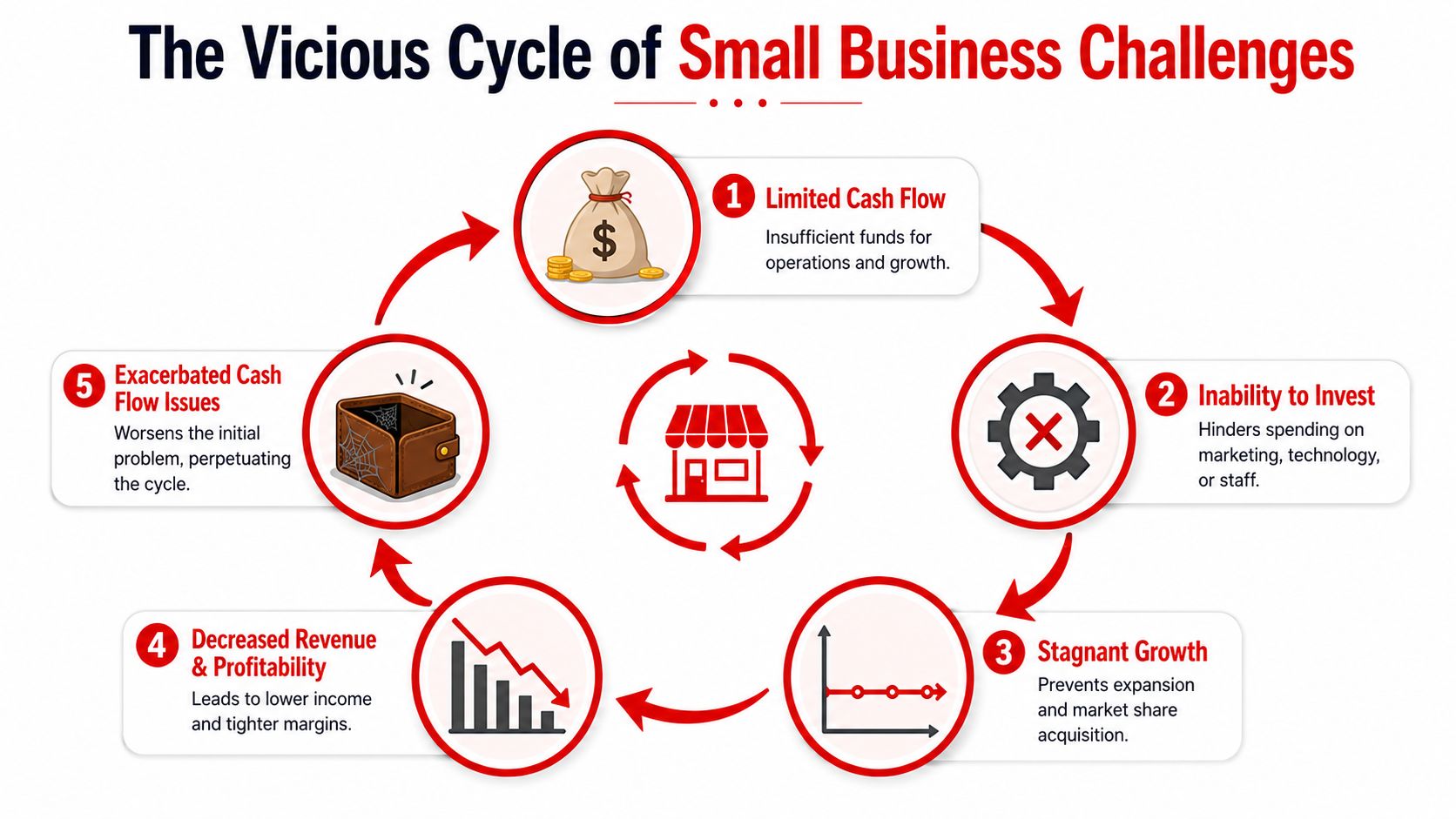
A better description is financial quicksand. Once the business steps into it, every weak move makes the next move harder. Limited cash delays investment. Delayed investment slows growth. Slow growth weakens revenue. Lower revenue tightens cash again.
How the cycle traps owners
Tighter lending standards in 2025 made this even worse by reducing credit availability and making it harder for businesses to manage supply chains and operating costs amid tariff-driven prices, according to the 2025 survey of business resource organizations from the Federal Reserve's small business research team. That's the piece many generic financing conversations miss. The problem isn't only approval difficulty. It's operational damage while the owner waits.
This cycle usually looks like this:
- Cash gets tight and the owner delays purchases.
- Operations suffer because systems, inventory, or staffing stay underfunded.
- Sales slow or fulfillment slips because the business can't perform consistently.
- Margins get squeezed by inefficiency and reactive decisions.
- The business looks weaker to lenders, which makes future funding harder.
Why this matters in advisory conversations
A broker who only asks, "How much funding is needed?" misses the true conversation. A stronger question is, "What cycle is this business stuck in?"
That changes everything. It shifts the role from application taker to problem solver.
For anyone studying business risk, a practical guide to risk mitigation is useful because it trains the eye to look at interconnected threats instead of isolated incidents. Lending strategy should work the same way. The right funding move should break a cycle, not just patch a hole.
Owners dealing with distress also need to understand what default risk looks like before they sign anything. A grounded review of default loan SBA issues can help frame the consequences of poor borrowing decisions and weak planning.
A good broker doesn't sell debt. A good broker helps the owner use capital with a purpose.
That distinction matters. It protects the client, and it creates better long-term referral relationships.
The Untapped Opportunity Becoming a Business Loan Broker
Every widespread business problem creates a market for people who can solve it. The funding gap is no exception.
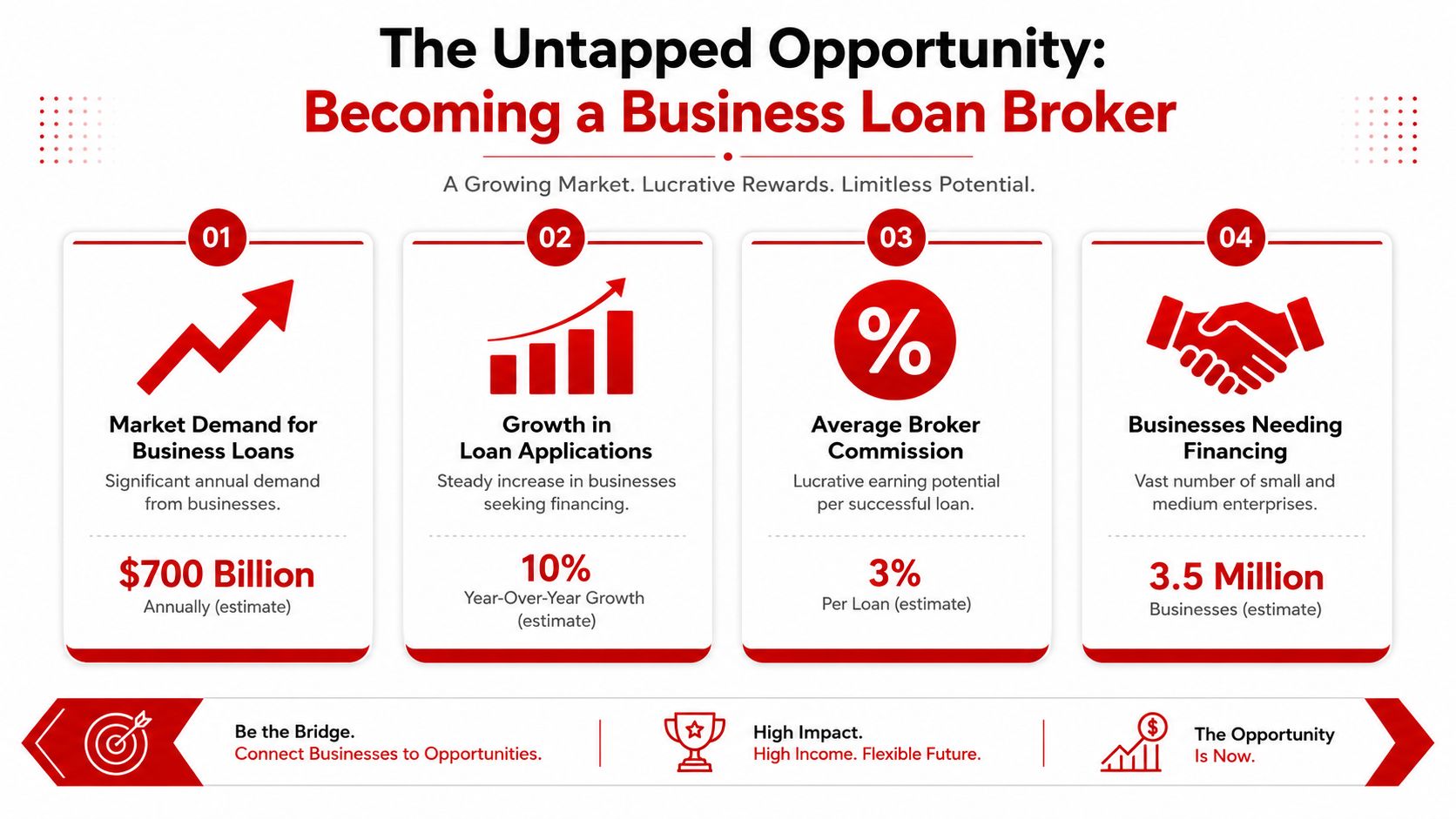
This is why business loan brokering deserves serious attention from aspiring entrepreneurs, consultants, sales professionals, CPAs, bankers, and service providers who want a remote business with recurring demand. Small businesses need capital. Alternative lenders exist to provide it. Someone has to bridge the two sides.
Why the market keeps expanding
The alternative lending market was valued at $354.82 billion in 2023 and is projected to reach $1,076.3 billion by 2033, growing at a 11.6% CAGR, according to Allied Market Research's alternative lending market release. That isn't a fringe niche. It's a large and growing funding ecosystem.
The implication is straightforward. Businesses are already using non-bank capital channels. As those channels expand, brokers become more important, not less.
What the broker actually does
A strong broker's role is practical:
- Qualify the business: Understand the use of funds, urgency, and operating reality.
- Package the file: Present the deal in a way lenders can evaluate efficiently.
- Match lender fit: Connect the client to an option that fits the business profile.
- Manage expectations: Explain terms, timing, and next steps clearly.
- Build referral loops: Stay useful to accountants, consultants, agencies, and local professionals who serve the same clients.
This is one reason the model works well from home. It's relationship-driven, phone-and-computer friendly, and built around process rather than physical inventory or office overhead.
Why this business model is durable
The need doesn't disappear when the economy gets tougher. In many cases, demand rises. Owners need working capital, equipment financing, startup funding, bridge funding, and growth capital in both expansion cycles and defensive cycles.
For people who want to enter the field, learning how to start a loan business matters because this isn't about randomly referring leads. It's about building a structured advisory business around real business needs.
The strongest part of the opportunity is that every funded client can lead to more business. One accountant, one consultant, one insurance professional, or one business owner can become a recurring referral source if the broker solves problems well.
Your Blueprint for a Recession-Resistant Business
A good business model should solve a painful problem, work without massive overhead, and stay relevant when the market gets shaky. Business loan brokering checks those boxes.
The alternative lending platform market is projected to grow from USD 3.82 billion in 2024 to USD 14,466.9 million by 2030, at a 25.4% CAGR, according to Grand View Research's alternative lending platform market report. That projection matters because digital infrastructure makes remote deal flow, lender access, and client communication easier to manage from anywhere.

Why the model fits modern entrepreneurs
This path appeals to several types of people:
| Background | Why the model fits |
|---|---|
| Sales professionals | They already know how to build trust and move conversations forward |
| Consultants and agencies | They already work with businesses that need capital |
| CPAs and financial professionals | They already see cash strain before the owner acts |
| Career changers | They want a lower-overhead path to independent income |
The model also offers flexibility. It can start part-time. It can run remotely. It can scale through partnerships and referrals instead of requiring a huge staff on day one.
Where structured training matters
Failure isn't typically due to a weak opportunity. Instead, it arises when individuals guess their way through lender relationships, deal packaging, compliance basics, and client conversations.
That's where a training platform such as Business Lending Blueprint fits. It teaches people how to start and grow a lending business by understanding funding products, lender matching, referral-based client acquisition, and remote brokerage operations. It doesn't provide loans. It teaches people how to build the business that helps owners access them.
Skills beat enthusiasm in this field. The person who can read a business problem correctly will outperform the person who only knows how to pitch.
That's especially important for professionals who want a recession-resistant income opportunity without chasing hype or unrealistic promises. This is a real business. It requires training, consistency, and trust.
Take the First Step to Your New Career Today
The biggest challenges for small businesses are not abstract. They are urgent, expensive, and widespread. Owners are dealing with rising costs, cash timing pressure, weak systems, supply chain strain, and limited access to flexible capital. Those problems create a continuing need for people who can help them secure funding through alternative lending channels.
That's why business loan brokering makes sense as a serious home-based business. It gives aspiring entrepreneurs a way to serve business owners, work remotely, build flexible income, and develop recurring referral relationships. It also gives professionals in adjacent industries a practical service to add without building a complicated operation from scratch.
The advantage is simple. A broker doesn't need to create a market. The market already exists. What matters is learning how to evaluate businesses properly, communicate funding options clearly, and connect owners to solutions that fit the situation.
For someone who wants a business tied to real economic need, this is one of the clearest paths available. It rewards judgment, follow-through, and relationship building. Those qualities tend to hold value in any economy.
The next move shouldn't be more passive reading. It should be action.
Business owners need capital, and trained brokers help them reach it. Business Lending Blueprint teaches people how to start a profitable lending business, work remotely, build referral relationships, and help companies access funding through alternative lenders. For anyone ready to explore the model seriously, the next step is to watch the free training or schedule a strategy session.