
A borrower walks in with a clean file, a decent credit profile, and a simple ask, working capital fast enough to avoid missing payroll. The problem is that the first quote looks cheap on paper, the second has a higher rate but lighter fees, and the third comes from a lender that won't explain how the repayments will hit cash flow. That's where a broker earns trust, not by pushing the lowest headline number, but by translating the deal into real cost, real timing, and real risk.
A smart business loan interest rates comparison starts with what the client needs, then works backward from there. The broker who can separate interest rate, APR, fees, amortization, and prepayment terms gives the borrower a better decision and protects the relationship from surprises later.
Table of Contents
- Introduction to Business Loan Interest Rates Comparison
- Understanding Interest Rate Versus APR and Fee Impacts
- Overview of Business Loan Products and Lender Types
- Comparing Rate Ranges Across Loan Products and Lenders
- Modeling All-In Loan Costs Over the Financing Lifecycle
- Case Studies and Calculator Examples for Brokers
- Strategies for Brokers to Evaluate and Present Loan Options
- Recommendations and Next Steps for Brokers
Introduction to Business Loan Interest Rates Comparison
A restaurant owner wants funds for inventory and a second location. One lender offers a bank-style term loan, another pushes an online installment product, and a third dangles quick capital with a factor rate instead of APR. On the surface, the cheapest quote wins, until the owner asks what the payment does to weekly cash flow and suddenly the “best” offer no longer looks obvious.
That's the whole job of a broker. The strongest operators don't sell money, they compare structures, pressure-test repayment, and match the offer to the business cycle. In a business loan interest rates comparison, the right answer depends on whether the borrower needs predictability, speed, flexibility, or room to refinance later.
| Comparison lens | What a borrower sees | What a broker should check |
|---|---|---|
| Headline rate | The advertised number | Whether fees are hidden elsewhere |
| Cash flow | The scheduled payment | How long the business can carry it |
| Product type | Term loan, line, advance | Amortization, draw rules, payoff terms |
| Lender type | Bank, online, alternative | Speed, collateral, and credit tolerance |
The market gives brokers plenty of spread to work with. In the euro area, the average business loan interest rate was 5.06% in July 2024, but pricing still varied materially by country, with Luxembourg, the Netherlands, and Malta among the lower-rate markets and Estonia and Latvia among the higher-rate ones, which shows why geographic context matters even inside one currency bloc. Euro area business loan rates by country
A borrower doesn't need a lecture. A borrower needs a clear recommendation. The broker who can compare offers across the full lifecycle of the loan gets there faster and makes the file easier to close.
Understanding Interest Rate Versus APR and Fee Impacts
The numbers that actually matter
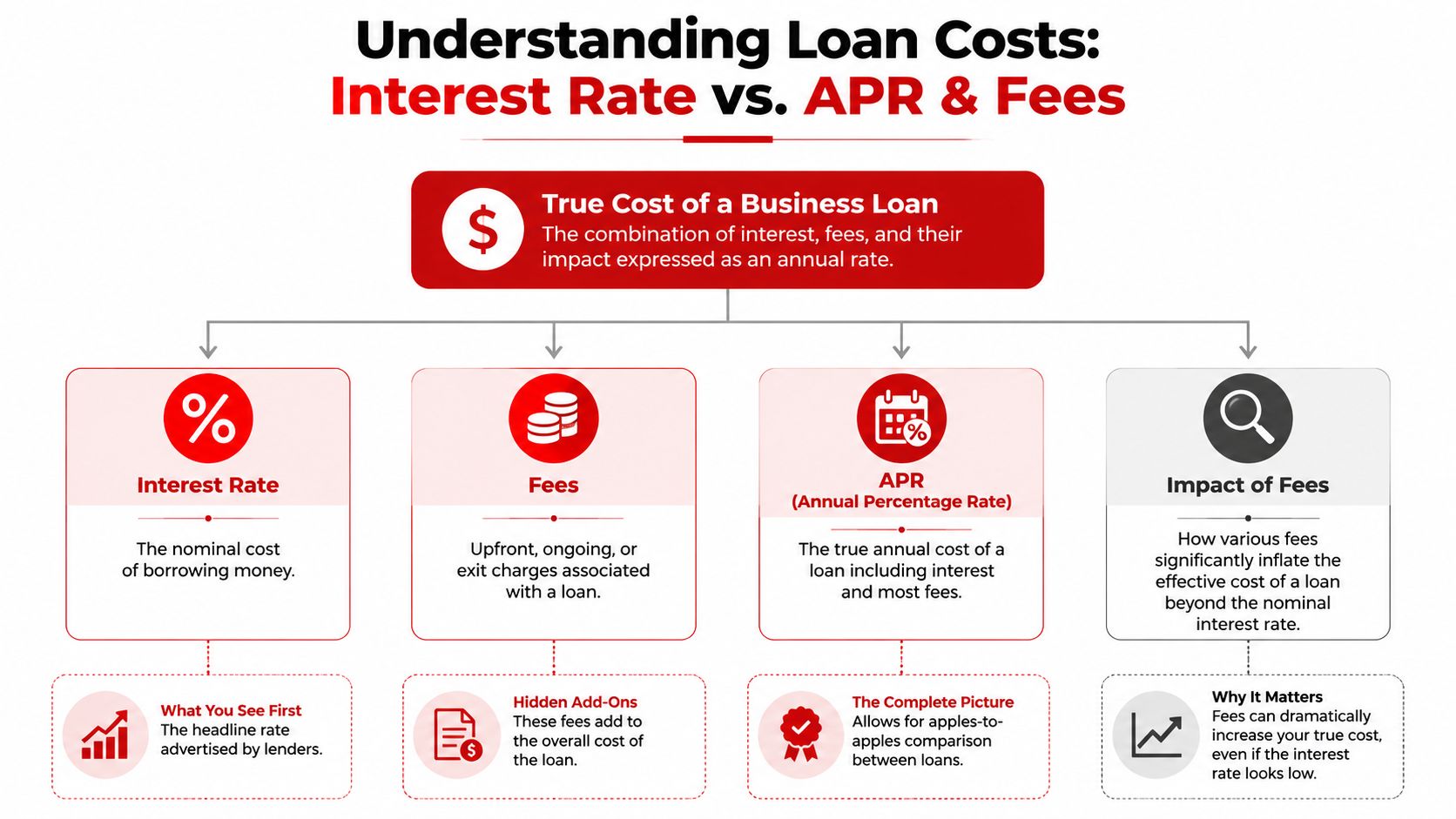
A lender can quote a low rate and still hand the borrower a costly deal. Interest rate is the price of borrowing principal, while APR adds interest and the fees that change the effective cost of capital. That difference decides whether the offer is truly competitive or just looks good on paper.
Practical rule: If the fee stack is not clear, treat the quote as incomplete.
Brokers need to compare the full structure, not just the stated number. Fixed-rate term loans are reported at about 7.23% median, while variable-rate term loans sit at 7.79% median. Business lines of credit are about 7.20% fixed and 7.80% to 8.10% variable. Those gaps are not cosmetic. They affect payment size, flexibility, and the borrower's total cost over time. Business loan rates and structures
Why factor rates break lazy comparisons
Merchant cash advances often quote factor rates instead of APR, which is why sloppy comparisons fall apart fast. A factor rate of 1.1 to 1.5 is not an annualized cost on its own, so treating it like an APR gives the borrower the wrong answer. The broker has to convert that offer into actual cash-flow terms before anyone calls it affordable.
SBA 7(a) loans are typically quoted around 9.75% to 14.75% fixed or 11.5% to 15% in some market summaries. That range explains why the same borrower can look overpriced in one product and reasonable in another. A broker who only compares the rate misses the actual trade-off, which is how the payment behaves over the life of the loan.
A low nominal rate can still be the wrong deal if it comes with a bad payment shape, aggressive fees, or a prepayment penalty that keeps the borrower locked in longer than expected.
The practical move is simple. Ask for the fee schedule, the payment schedule, and the prepayment language. If the lender only talks about rate, assume there is hidden cost in the structure.
Overview of Business Loan Products and Lender Types
Match the product to the use case
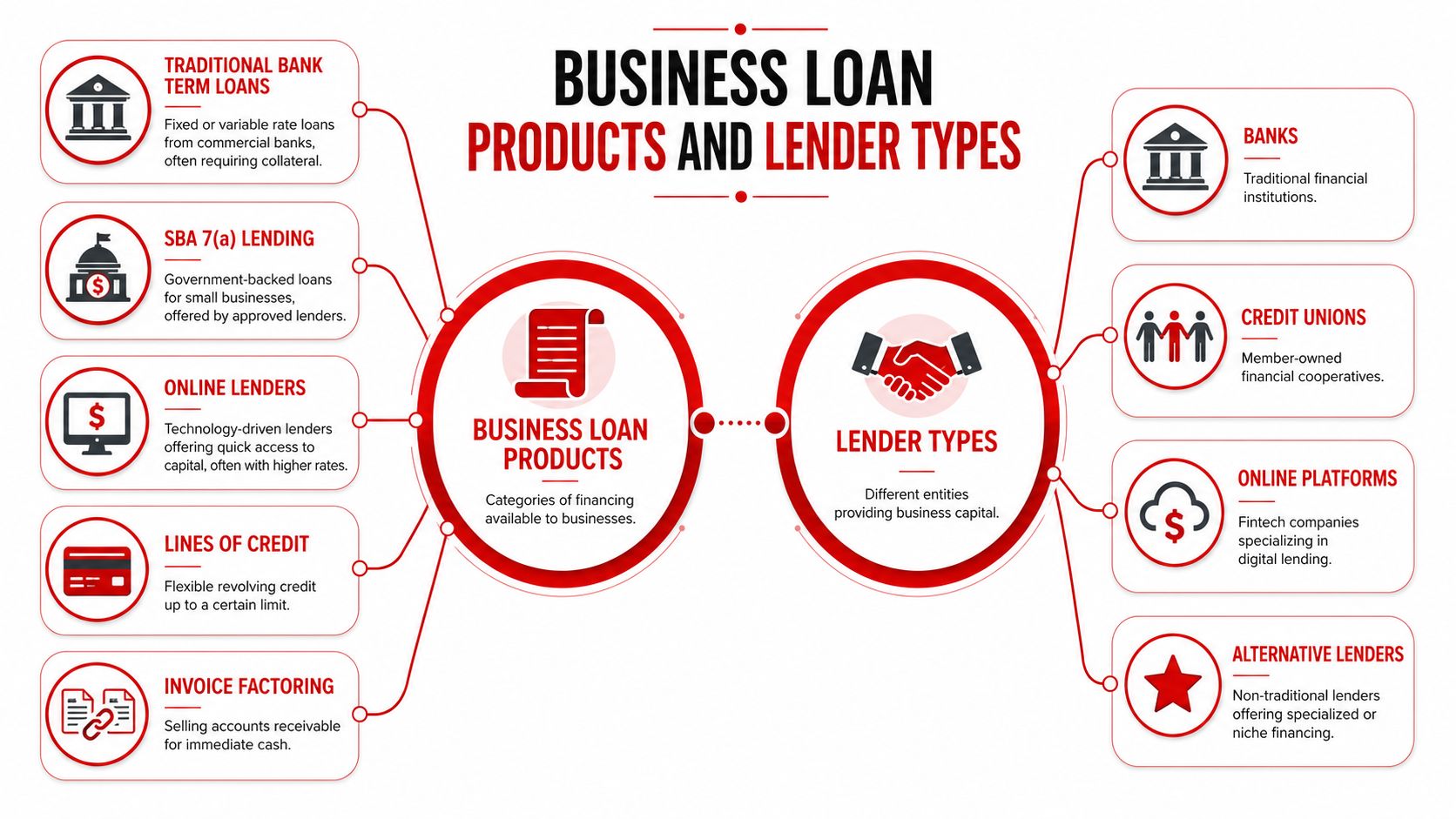
Brokers don't win by memorizing a rate sheet. They win by knowing which lender type fits which borrower profile. A cash-rich established company may want a bank term loan. A newer company with volatile revenue may need an alternative structure. A seasonal business may care more about draw flexibility than a low fixed rate.
What each lane usually looks like
- Traditional bank term loans: Best for borrowers with stronger credit, cleaner statements, and patience. These deals usually reward stability, but underwriting is tighter.
- SBA 7(a) lending: Useful when a borrower needs a longer runway or can't land conventional financing. The structure can help, but the paperwork is heavier.
- Online term loans: Often faster to fund, which is why they come up when urgency matters more than pristine pricing.
- Lines of credit: Good for working capital swings, inventory purchases, and short-term draws. Flexibility is the appeal, not the lowest total cost.
- Merchant cash advances: Usually a last-mile capital solution when speed and approval flexibility outweigh price concerns.
Independent guidance describes a business loan broker as someone who is not tied to one lender and can compare offers from many lenders after reviewing financial information on the borrower's behalf. That model is built for small businesses that don't have time to apply one by one. How business loan brokers compare lenders
Where the broker earns leverage
A solid broker knows the lender mix, not just the product names. Banks usually want more documentation. Alternative lenders usually trade lower documentation for higher pricing or shorter terms. That trade-off is often acceptable when the business needs speed, but it should be explained plainly.
For a deeper comparison between recurring credit and installment debt, a useful internal reference is this term loan versus line of credit guide. The key is not picking a favorite product, it's aligning the structure with the borrower's actual repayment pattern.
Comparing Rate Ranges Across Loan Products and Lenders
Headline spreads are enormous
A borrower can look solid on paper and still get wildly different pricing depending on lender type. That is the point brokers need to make early. Business loan rates and fees overview shows how wide the gap can be across banks, online lenders, SBA loans, and merchant cash advances, and that gap is exactly why headline pricing alone does not tell the full story.
| Typical APR Ranges by Product and Lender Type | Bank APR | Online APR | Merchant CA APR | SBA APR |
|---|---|---|---|---|
| Term loan style financing | 6.37% to 10.98% | 14% to 99% | Not typical | 9.75% to 14.75% |
| Revolving or short-term capital | 6.37% to 10.98% | 14% to 99% | 40% to 350% | 9.75% to 15% |
| Flexible alternative funding | 6.37% to 10.98% | 14% to 99% | 40% to 350% | Product dependent |
Use that spread as a screening tool. If a borrower has strong liquidity and good credit, do not accept a high-cost online offer without first checking whether a bank or SBA structure fits better. If the borrower needs speed, thin documentation, or easier approval, the higher range may be the right trade-off, but the monthly burden has to be clear before anyone calls it a fit.
Geography still changes the answer
Pricing is not identical across markets, even before you get into borrower quality. A deal that pencils in one country, region, or currency zone may look expensive in another, and brokers should say that plainly when clients are comparing offers across borders or against local peers. For brokers tracking small business loan interest rate trends, the lesson is simple, rate range is only the first filter, and the borrower's market position fills in the rest.
For higher-cost, asset-driven financing, review this hard money commercial loan overview. Those deals sit in a different bucket and should be presented that way, with the full repayment burden front and center.
What to tell the client
Say it straight. Bank money is usually cheapest. SBA pricing can also be attractive for the right borrower, but the underwriting path is stricter and slower. Online and alternative funding usually costs more because the lender is getting paid for speed, flexibility, or weaker collateral support.
That message is what separates a broker from a rate reader. Show the spread, explain the trade-off, and make the borrower choose with eyes open.
Modeling All-In Loan Costs Over the Financing Lifecycle
Build the comparison around time, not just rate
A borrower doesn't pay APR in a vacuum. The business pays monthly, weekly, or daily, and the core question is what the capital costs over the exact time it stays on the balance sheet. That's why the best brokers model the loan over its full financing lifecycle instead of waving around one annual number.
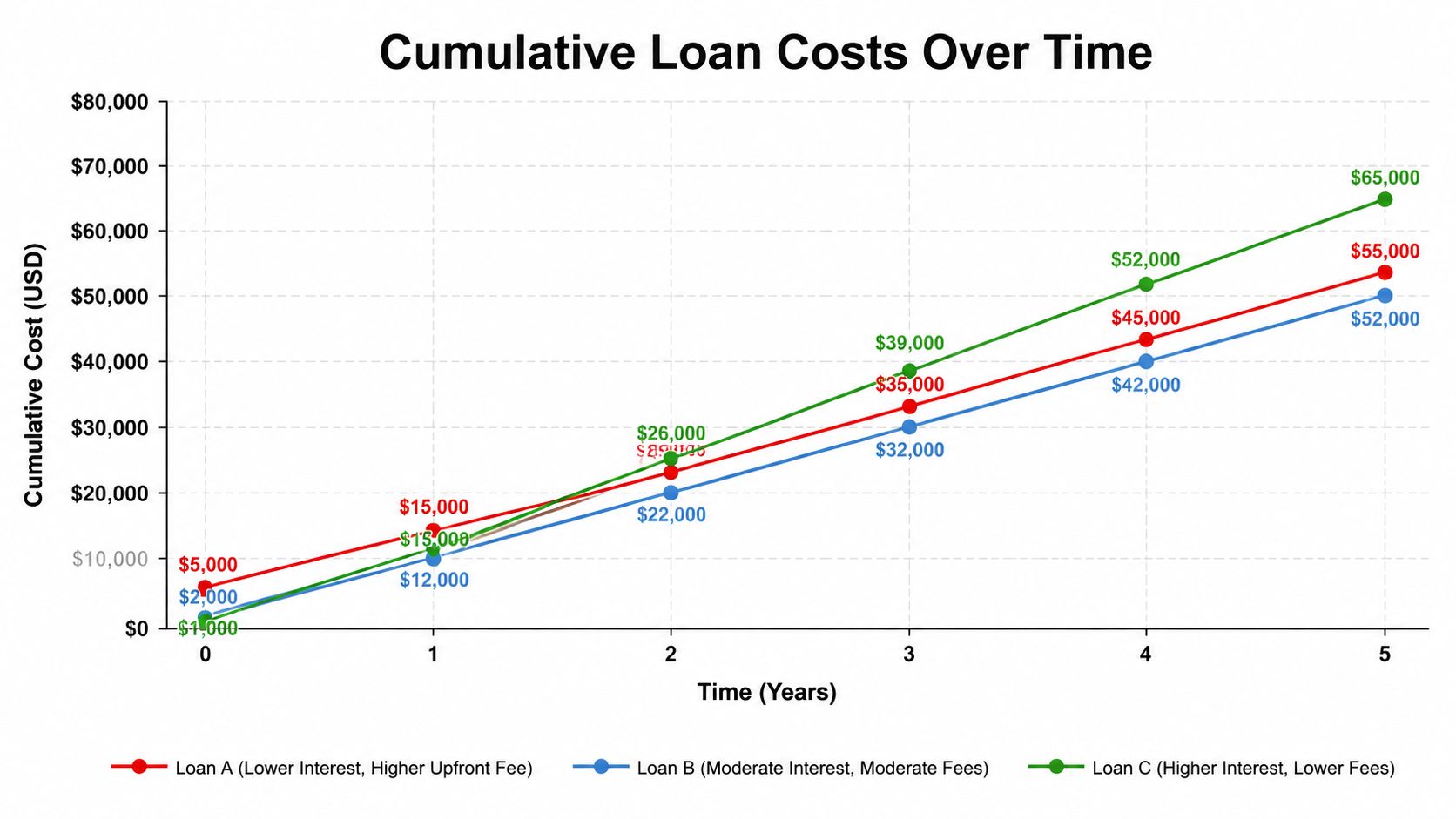
A neutral bank-source guide says borrowers should compare APR, fees, monthly-payment impact, and prepayment structure, then model best-case, worst-case, and stress-case revenue before choosing a loan. That advice is the right standard for brokers too. Business loan interest rates and loan cost factors
Use a simple cost model
A practical broker spreadsheet doesn't need to be fancy. It needs to answer three questions quickly.
- What is the total cash outflow? Include funding fees, periodic fees, and payoff costs.
- What happens if the loan is held longer than planned? Variable pricing and renewal structures can change the answer.
- Does early repayment save money or waste it? Some products reward faster paydown, others punish it.
Broker rule: If a client might refinance within the term, the broker should compare the current offer against the refinance path, not just against today's rate.
An internal reference on debt service coverage ratio calculation belongs in this workflow because repayment capacity determines whether the modeled cost is survivable. A rate that looks fine can still fail if the payment hits too hard relative to incoming cash.
The recommendation
For every file, compare at least one fixed option, one variable option, and one alternative option. Then ask which one leaves the borrower with enough operating room after debt service. That's the number that matters when the market gets messy.
Case Studies and Calculator Examples for Brokers
A retailer wanted inventory capital before a busy season. The file qualified for a traditional term loan near 7%, but the alternative quote came in at 12% with lower upfront friction. On paper, the second offer looked faster and easier. Once the broker ran the numbers through a loan calculator, the lower fee did not offset the cost over the holding period, and the effective annual burden came out much higher than the client expected.
The second file involved a startup comparing a merchant cash advance with revenue-based financing. The MCA pitch looked simple because it used a factor rate, but factor pricing hides the actual cost when compared against installment debt. After the broker converted the advance into an effective cost view, the borrower saw that the repayment pace could choke working capital during a slow month. For a practical calculator workflow, an internal reference is this business building loan calculator guide.
What the calculator should show
- Payment timing: Daily, weekly, or monthly changes cash pressure.
- Total payoff cost: The borrower needs the full number, not just the headline rate.
- Early exit impact: If refinancing is likely, payoff assumptions matter.
- Revenue stress: Slow sales change the result fast.
The broker's value is not in making the math look complicated. It's in making it understandable enough for the borrower to choose confidently. A clean one-page summary with the offer, the payment path, and the exit cost beats a vague “competitive rate” claim every time.
Strategies for Brokers to Evaluate and Present Loan Options
Be transparent about commissions and incentives
Brokers are generally paid on a commission-only basis, and that reality should be handled cleanly, not buried. One industry guide says commissions typically range from 2% to 20% depending on the product, with direct lenders and banks at 2% to 5%, alternative lenders at 5% to 10%, merchant cash advance and revenue-based financing at 8% to 15%, and high-risk or specialized products up to 20%. Business loan broker income guide
That doesn't mean the broker should chase the highest payout. It means the broker should disclose the compensation context and still lead with the best-fit structure. Clients can handle economics. What they won't tolerate is surprise.
Present the deal in buckets
A strong proposal groups choices by borrowing cost and use case.
- Low-cost bucket: Usually bank or SBA style deals for qualified borrowers.
- Middle-cost bucket: Often structured online lending or flexible credit lines.
- High-cost bucket: Typically merchant advances or specialized products.
That format helps the borrower see trade-offs fast. It also makes the broker's recommendation easier to defend when the cheapest option isn't the best operational fit.
For a useful operational lens on keeping the brokerage lean, strategies for boosting profit can be adapted to a referral-based lending business by trimming wasted follow-up, standardizing document collection, and reducing time spent on unqualified files.
The fastest way to lose a client is to hide the fee, the slowest way is to explain the fee badly.
The best brokers use side-by-side summaries, label the key terms, and state the reason for the recommendation in one sentence. If the borrower needs speed, say so. If cash flow stability matters more than the lowest nominal rate, say that too. Credibility closes more deals than hype.
Recommendations and Next Steps for Brokers
Standardize the comparison process. Every file should be checked for headline rate, APR, fees, payment schedule, term length, and payoff language before a recommendation goes out. That single habit keeps the broker from selling the wrong deal with confidence.
Build your presentation around all-in economics. A borrower wants to know what the loan does to the business over time, not just what it says on page one of the term sheet. If the deal doesn't survive a cash-flow stress test, it's not the right deal.
Keep growing referral relationships with multiple lender types. The broker who can offer options across banks, online lenders, and alternative capital sources is harder to replace and easier to trust. Over time, that trust turns into repeat funding, renewals, and referral-driven income.
Business Lending Blueprint is built for people who want to learn how to start a profitable lending business from home, without becoming a lender. The training shows how to compare offers, work with business owners, and build a remote brokerage model that can scale through relationships and repeat business.
A CTA for Business Lending Blueprint.