A lot of founders are sitting in the same spot right now. The business idea is real, the need for capital is urgent, and the personal credit score is the part that keeps killing momentum. Banks say no, forms disappear into underwriting, and every rejection starts to feel personal even when it's just lazy risk filtering.
That's the wrong way to read the situation. Weak credit doesn't mean the business is weak. It means the founder needs a sharper strategy, a better lender fit, and a cleaner presentation. It also creates an overlooked advantage. A founder who learns how to manage start up business loans with bad credit learns the exact process other business owners struggle with every day, and that knowledge can become a serious home-based brokerage business later.
Table of Contents
- Why Bad Credit Should Not Stop Your Startup
- Assess Your Eligibility And Prepare Key Documents
- Compare Lender Types For Bad Credit Startups
- Set Up Your Business Structure And Financial Projections
- Use Scripts And Checklists To Streamline Applications
- Take Quick Credit Repair Actions And Analyze Cost Tradeoffs
- Start A Loan Brokerage To Turn Deals Into Income
Why Bad Credit Should Not Stop Your Startup
A common founder story goes like this. The owner has a solid service business concept, some early customer interest, and enough skill to execute. Then the bank sees a score under 600 and the conversation dies.
That outcome is normal at banks. It isn't the end of the road. Entrepreneurs with credit scores under 580 face significantly diminished approval odds for startup financing, with traditional banks approving only 5% to 15% of applications while alternative online lenders raise that probability to between 10% and 25% according to this breakdown of startup loans for bad credit borrowers. The approval gap reveals a clear picture. The problem often isn't the business. The problem is applying to the wrong capital source first.
Rejection usually means mismatch, not failure
A founder with bruised credit who keeps chasing bank underwriting wastes time and burns confidence. A founder who pivots toward lenders that care about cash flow, collateral, or the business plan has a real shot.
Practical rule: A bank decline should be treated as a routing problem, not a verdict.
That same founder also needs to stop treating funding as a one-time event. Learning how to package a file, answer lender objections, and choose the right product creates a repeatable skill set. That skill set can help secure the founder's own capital first, then open the door to helping other owners do the same.
For founders trying to stabilize access to revolving capital while rebuilding their profile, a business credit card for bad credit can also become part of the broader funding mix.
Assess Your Eligibility And Prepare Key Documents
Bad-credit applications fall apart for one of two reasons. The borrower applies to lenders that were never a fit, or the file looks sloppy. Both are avoidable.
Start with the file before the application
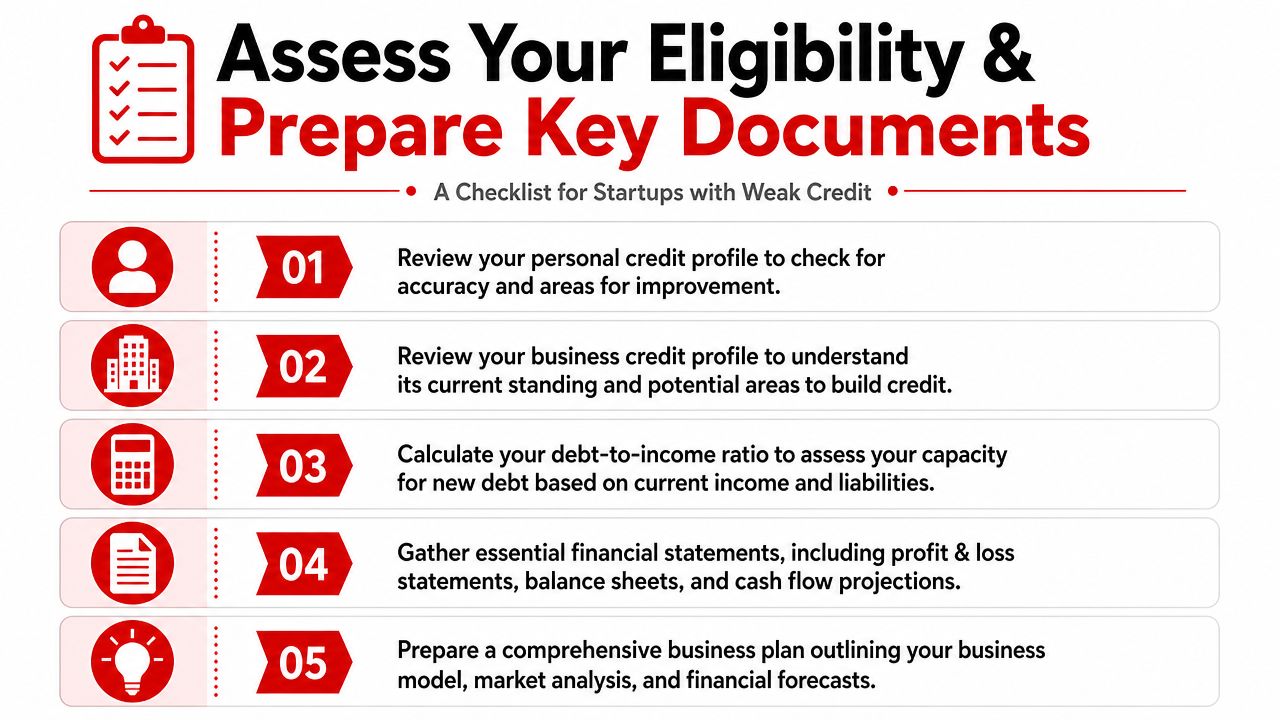
A founder should review personal credit first, not to obsess over the score, but to catch errors, old balances, and obvious red flags. Business credit matters too if it exists, but many early-stage lenders still lean heavily on the owner's profile and the company's bank activity.
Then comes debt pressure. Lenders look at existing obligations because those payments compete with the new loan. If the founder already has high card balances, overdue accounts, or unstable monthly obligations, that has to be addressed before submitting anything.
A practical prep folder should include:
- Personal credit review notes: disputed items, current balances, and any explanation for major derogatories.
- Business formation records: entity documents, EIN confirmation, business license if required, and ownership details.
- Bank statements: consistent deposits matter because lenders use them to judge repayment ability.
- Tax documents: personal and business returns if available.
- Financial statements: profit and loss statement, balance sheet, and cash flow projections.
- Business plan: concise, readable, and tied directly to how the funds will be used.
Build the lender's answer file
Most founders send documents only when asked. That slows everything down and signals inexperience. A stronger approach is to create an answer file in advance. Every likely underwriting question should already have a document, note, or short explanation ready.
Clean files get faster decisions. Messy files trigger more emails, more delays, and more silent declines.
A short business plan beats a bloated one. It should explain the offer, target customer, revenue model, use of funds, and why the business can repay. A founder doesn't need fancy formatting. Clarity wins.
For anyone unsure what lenders usually ask for, this guide to requirements for a commercial loan is a useful checklist to mirror before submitting a startup request.
Eligibility should be judged realistically
A founder with weak credit and no revenue should stop chasing products built for mature companies. A founder with active deposits, signed contracts, or purchase orders has a much stronger argument. The point isn't to hope underwriting overlooks problems. The point is to package the strengths so the file makes sense on first review.
A clean submission says three things fast:
| What the lender wants to know | What the founder should show |
|---|---|
| Is the business real? | Formation documents, license, website, customer activity |
| Can it repay? | Bank statements, projections, current revenue pattern |
| Is the owner credible? | Clear explanation of credit issues and clean documentation |
Compare Lender Types For Bad Credit Startups
A bad-credit founder shouldn't ask, “Who will approve this?” The better question is, “Which product fits the business model without creating a repayment mess?” Those are different questions, and they lead to better outcomes.
Which products are realistic
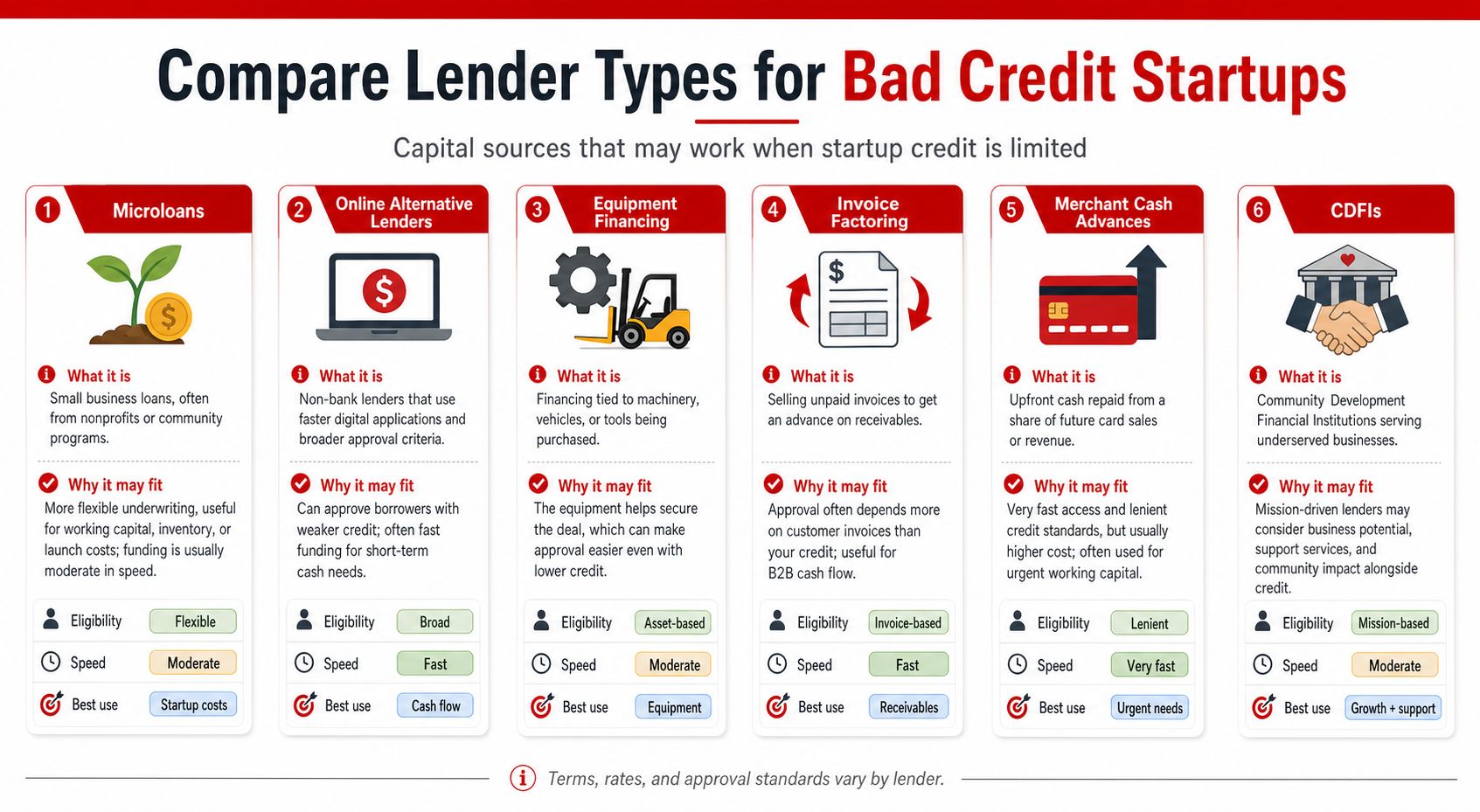
Some funding categories are built for imperfect credit. Several common bad credit business loans, including invoice factoring, equipment financing, revenue-based financing, and microloans explicitly accept personal FICO scores as low as 500 according to this review of bad-credit business loan options.
That matters because it changes the conversation. Instead of begging a bank to ignore credit, the founder can choose a product that already expects credit issues and underwrites around them.
Side-by-side lender logic
| Lender type | Best fit | Main strength | Main drawback |
|---|---|---|---|
| Microloans | Early-stage founders with a solid plan | More flexible review | Slower process and smaller approvals |
| Online alternative lenders | Businesses with active deposits | Fast decisions and practical underwriting | Higher cost is common |
| Equipment financing | Companies buying needed equipment | Asset-backed structure can help weak credit | Funds are tied to equipment use |
| Invoice factoring | B2B companies with unpaid invoices | Focuses on receivables more than owner score | Not useful without invoices |
| Merchant cash advances | Businesses with strong card sales | Fast access when revenue is active | Repayment pressure can be intense |
| CDFIs | Underserved founders with a strong story | Holistic review of borrower and mission | Approval takes patience |
Revenue decides more than founders think
A lot of founders confuse bad credit with no credit check. That mistake wastes applications. Revenue-based products often don't care much about the score, but they do care whether money is hitting the account.
Some lenders that focus on cash flow want to see consistent monthly deposits. Founders with no revenue, irregular revenue, or fresh entities with no bank activity usually won't fit those products yet. That's why bank statement positioning matters so much for this category. Founders looking at bank statement business loans should pay close attention to deposit consistency before they apply.
A founder with ugly credit and solid deposits is often more financeable than a founder with decent credit and no cash flow.
The smart way to choose
Product choice should follow the use of funds.
- If the business needs equipment, equipment financing is usually cleaner than taking expensive unsecured money.
- If customers already owe invoices, factoring can unlock working capital without making personal credit the star of the file.
- If the company has steady sales but weak credit, an online lender may be realistic.
- If the founder is very early and needs patient underwriting, microlenders and CDFI-style options often make more sense.
A fast close isn't always a good close. Quick money can solve one problem and create another if repayment starts choking operations the next week.
Set Up Your Business Structure And Financial Projections
Founders with weak credit don't get much room for sloppiness. If the legal structure is vague and the numbers feel improvised, the file dies fast.
The first fix is business structure. A lender wants to know who owns the business, who signs for it, and whether the entity is organized like a real company instead of a side project. The founder should have the entity documents in order, the ownership split documented, and the business purpose stated clearly.
Clean structure builds lender confidence
The exact entity type depends on tax and legal advice, but the lender's concern is simpler. The file needs consistency. The business name should match the bank account, formation records, application, and supporting documents. Addresses, dates, and ownership percentages should line up.
That sounds basic because it is. Yet a lot of applications get slowed down because one document says one thing and another says something else.
Cash flow matters more than founder pride
For startups with weak personal credit, projections aren't optional. For startup applicants with FICO scores under 600, approval rates at large banks drop to less than 2%, while online alternative lenders offer higher approval rates between 15% and 35% by focusing on cash flow according to this analysis of bad-credit business loan approval patterns. That means the founder needs a simple, believable repayment story on paper.
A useful projection doesn't need a giant spreadsheet. It needs a short monthly model that shows:
- Revenue assumptions: where sales come from and why the estimate is reasonable
- Core expenses: payroll, rent, software, materials, marketing, and debt service
- Cash flow view: what comes in, what goes out, and what remains after obligations
- Use of funds: exactly how the loan supports revenue or delivery
Underwriters don't need fantasy. They need numbers that survive five minutes of scrutiny.
A two-page projection beats a bloated deck
A founder should be able to explain the projection in plain language. If revenue ramps, the reason should be visible. If expenses spike, the business should show what that spending produces. If the company needs working capital before customer payments arrive, the timing should be obvious.
One practical method is to build a base case, then test it against a slower-sales version. If the business only works under perfect conditions, the lender will spot that immediately.
For founders who need help pressure-testing repayment math, a business building loan calculator can help map how projected cash flow lines up with likely debt obligations.
Use Scripts And Checklists To Streamline Applications
Most founders lose time in the follow-up, not the application. Documents get sent. Silence follows. Then the borrower starts guessing.
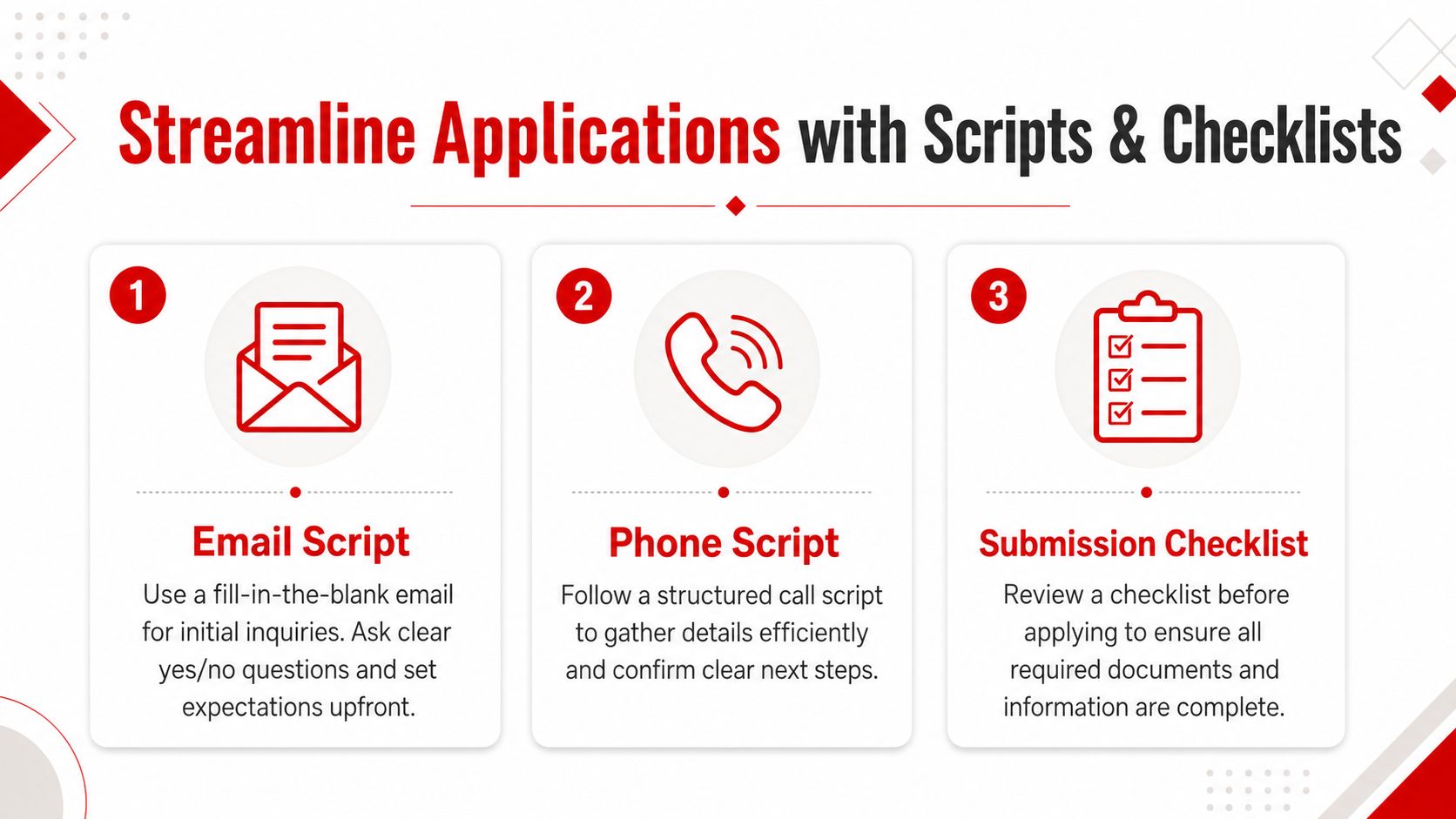
A better process uses scripts. The goal isn't to sound polished. The goal is to force clarity and next steps.
Simple scripts that move files
Initial outreach email
Subject: Startup funding request with supporting file
The business is seeking funding and has weak personal credit, but the file includes current business details, bank activity, and use of funds. Please confirm whether this profile fits current lending parameters and list any missing items needed for review.
Follow-up call script
- Open directly: “This is a follow-up on the application submitted for review.”
- Ask the only question that matters first: “Is the file currently workable, yes or no?”
- Then narrow it down: “If not, what specific item is stopping movement?”
Gap-clarification email
Thanks for the update. Please reply with the exact documents or explanations needed so the file can move to a complete review. The business will return each item in one submission.
The checklist that saves deals
A founder should track every file with one submission sheet. No memory. No scattered inbox threads.
- Document sent date: when each item went out
- Contact owner: who has the file now
- Open questions: what underwriting still needs answered
- Next follow-up date: when the founder checks back
- Status: submitted, incomplete, in review, approved, declined, or countered
For founders sending document packages to multiple funding contacts, mastering PDF mail merge is a practical resource for standardizing attachments and reducing manual follow-up mistakes.
The founder who tracks lender communication like a sales pipeline gets more answers than the founder who “checks in” whenever anxiety spikes.
Keep communication tight
Long emails hurt. Defensive explanations hurt more. Lenders want a complete file, direct answers, and fast responses. That's it.
A short script also helps if the founder later decides to become a broker. The same habits that speed up personal funding files become part of a scalable application system for clients.
Take Quick Credit Repair Actions And Analyze Cost Tradeoffs
Bad credit doesn't improve because a founder needs capital badly. It improves because specific weak points get fixed. Some actions can be taken quickly, and they matter because many alternative products still have floor requirements.
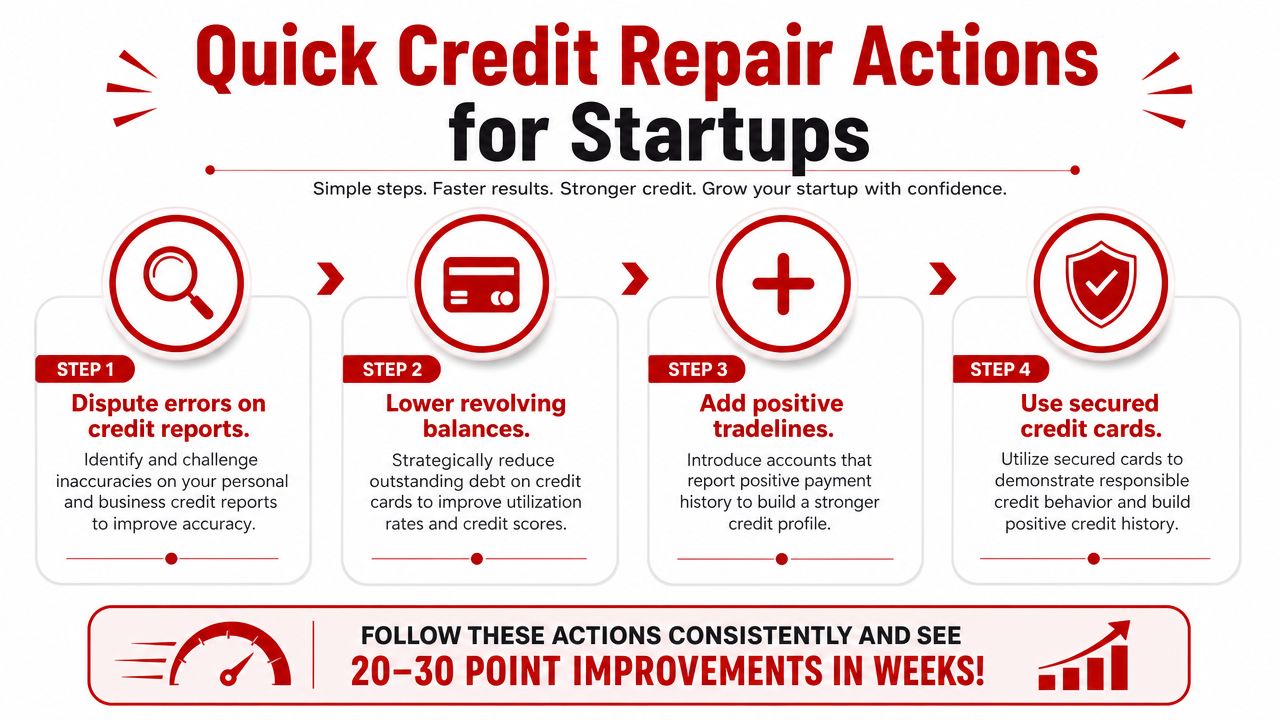
Fast cleanup moves that actually help
Dispute obvious reporting errors. Wrong balances, duplicate accounts, and accounts that should show closed can drag a file down for no good reason.
Lower revolving balances where possible. Even a modest paydown can improve how the profile looks because lenders see less immediate pressure.
Add positive payment activity. If the founder can responsibly add accounts that report clean payment history, that can strengthen the file over time.
Use secured credit carefully. The point isn't to stack more debt. The point is to establish cleaner behavior and reduce the weight of old mistakes.
The reason this matters is simple. For startups specifically seeking capital with bad credit, the typical minimum credit score requirement to qualify for many easy-approval or alternative startup loans is approximately 500, with online lenders reporting an average approval rate of roughly 24% according to this review of easy-approval startup business loans. If the founder is close to that floor, small improvements can change which doors are open.
Cost matters more than approval
Getting approved is not the finish line. The critical question is whether the money helps or traps the business.
A founder should compare offers using a simple worksheet:
| Cost factor | What to check |
|---|---|
| Rate structure | Is pricing stated clearly and understood |
| Fees | Are there origination or other upfront charges |
| Payment frequency | Daily, weekly, or monthly changes the cash strain |
| Total payback | What the business repays in dollars, not just rate language |
| Term length | Whether the business can handle the pace comfortably |
Pick the cheapest usable money, not the fastest money
A short-term product with aggressive repayment can starve payroll, inventory, or marketing. A slower, more structured product may be harder to get, but it can leave the business breathing room.
Founders should test each offer against actual operations:
- If sales dip temporarily, can the payment still be made?
- If customer payments slow down, does the structure break cash flow?
- If the funds are used exactly as planned, does the business generate enough margin to justify the financing?
A bad loan is worse than no loan when repayment blocks the business from growing.
The best deal usually isn't the one with the smoothest sales pitch. It's the one the business can carry without constant stress.
Start A Loan Brokerage To Turn Deals Into Income
A founder who learns how to manage ugly files, fix weak applications, and place deals with the right lenders has built a marketable skill. Most business owners have no idea how to package themselves for funding. They either apply blindly or give up after a bank says no.
That gap creates an opening for a home-based loan brokerage. The work is practical. Build referral relationships with professionals who already serve business owners, keep a clean intake process, and connect borrowers to the right alternative lending channels. The model works well for consultants, sales professionals, CPAs, bankers, and service providers because the conversations already exist.
Why this turns into recurring opportunity
Business owners rarely need funding once. They need it repeatedly across growth phases, equipment purchases, working capital needs, and cash flow gaps. A broker who handles one file well can earn repeat business and referrals.
The strongest operators don't chase strangers all day. They build systems. They stay organized, move files fast, and communicate clearly. Resources on Proven deal acceleration strategies can help sharpen the operational side of moving opportunities from inquiry to funded deal without letting momentum die.
The brokerage model fits remote work
This is one of the cleaner recession-resistant service businesses available because it can be run remotely, scaled through referrals, and expanded through repeat relationships. It doesn't require inventory, a storefront, or a giant team to get started. It does require training, discipline, and a process that protects both the broker and the client.
Business Lending Blueprint does not provide loans. It teaches people how to build a lending business around helping owners access funding through alternative lenders, with systems designed for flexible, home-based work and long-term referral growth.
Business owners and aspiring brokers who want a direct path into this industry should start with the free training at Business Lending Blueprint. It shows how to build a profitable lending business from home, work with vetted lender networks, support clients seeking funding, and create a scalable income stream without relying on cold calling. For readers who want a more personalized path, scheduling a strategy session is the fastest next step.