A lot of people looking up how to start a broker company are in the same spot. They're good at sales, consulting, banking, tax, or client relationships, but they're tired of trading time for a paycheck that feels capped. They want a business they can run from home, one that helps real business owners solve a real problem, and one that doesn't depend on a perfect economy to stay relevant.
Business loan brokering fits that need unusually well. Small business owners still need capital when banks say no, and brokers sit in the middle by packaging deals, matching borrowers with lenders, and earning commissions when funding closes. That makes it attractive to career changers, CPAs, consultants, bankers, and side-hustlers who want flexible work with room to scale.
The mistake is assuming the only way in is the heavyweight route with full licensing, major infrastructure, and high startup costs. That path exists, but it's not the only path. A smarter launch often starts smaller, cleaner, and faster. Someone who's still sorting out qualifications should review the core requirements first through this guide on finance broker qualifications.
This playbook is built for the person who wants a practical business, not a fantasy. The focus stays on choosing the right model, setting up the company correctly, building lender relationships, creating referral-driven deal flow, and running files properly so deals fund.
Table of Contents
- Introduction to Starting Your Broker Company
- Choosing Your Broker Niche
- Setting Up Your Legal Structure and Compliance
- Building Your Lender Network and Pricing Strategy
- Acquiring Clients with Referral and Digital Methods
- Creating Efficient Operations and Deal Flow Scripts
- Conclusion with Launch Checklist and 90-Day Roadmap
Introduction to Starting Your Broker Company
Individuals often don't start here because they've dreamed of “brokering” since childhood. They start here because they've seen enough of the working world to know what they don't want anymore. They don't want a business with heavy payroll on day one, a storefront lease, or a model that dies when the market tightens.
A broker company, especially in business lending, can be built around relationships, packaging skill, and consistency. That matters because a good broker doesn't need to manufacture a product. The broker identifies a business owner's funding need, gathers the right file, places it with the right lending partner, and earns a commission when the deal funds.
Practical rule: The launch gets easier when the founder stops trying to look like a giant firm and starts acting like a sharp specialist.
That's why the early decisions matter more than the logo, the website color palette, or the business cards. The founder who picks the right model, stays inside the rules, and builds a referral engine can create a home-based company with low overhead and real earning potential. The founder who copies generic “broker startup” advice usually wastes time on the wrong structure and the wrong marketing.
A broker business also has one advantage many service businesses don't have. It can scale through lender relationships and referral partnerships rather than through headcount alone. That makes it attractive for professionals who want flexibility, remote work, and recurring referral relationships instead of constant prospecting from scratch.
Choosing Your Broker Niche
The first big decision isn't branding. It's structure. Too many people researching how to start a broker company default to the most expensive version because that's what most guides talk about.
Three models and one clear recommendation
According to startup data on introducing broker and white-label growth, most content still assumes a full-license path with $50k to $100k net capital and SEC or FINRA registration, while the more accessible introducing broker and white-label paths can launch with under $5k and near-zero licensing in some setups. That same source states 68% of new brokerage entrants in 2024–2025 chose introducing broker or BaaS-style setups, only 12% of search-result guides explained that path clearly, and these lower-barrier models now account for over 40% of new broker firms globally.
That's the market speaking. New entrants want speed, lower fixed cost, and less regulatory drag.
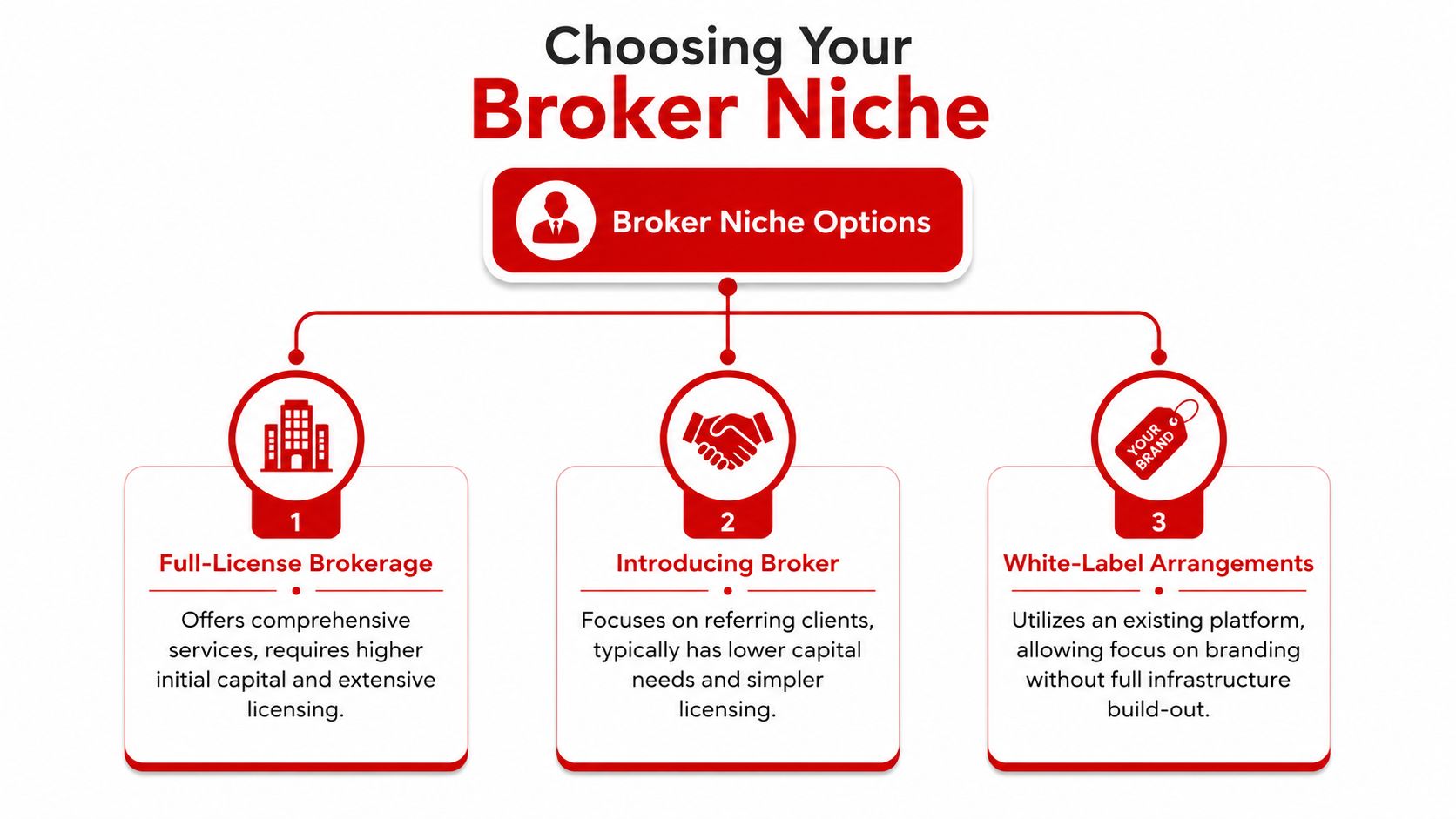
For most first-time founders, the best choice is usually one of these:
- Introducing broker model: This works well for someone who wants to focus on sourcing clients and packaging files, then hand placement and funding execution to lender partners or a larger network.
- White-label arrangement: This fits someone who wants branded presence without building full infrastructure from zero.
- Full-license brokerage: This is the right move only when the founder has substantial capital, compliance resources, and a specific reason to own the full stack.
The fastest way to get stuck is to choose the model that sounds impressive instead of the one that can actually launch.
How to pick a funding niche that closes
A niche shouldn't be chosen by trend. It should be chosen by fit.
A practical filter looks like this:
- Look at existing access. A CPA may start with working capital and tax-related cash flow cases. A consultant serving healthcare may look at sectors connected to medical practice loans. A real estate professional may lean into investor and business-purpose funding conversations.
- Match the niche to document complexity. Some products require tighter documentation and more borrower education than others.
- Choose deals that referral partners can understand quickly. If the partner can't explain what gets funded and who qualifies, the referral channel won't stick.
A strong beginner niche is one that sits at the intersection of market demand, clear borrower pain, and familiar referral sources. Broad at the start is fine. Confused is not.
Setting Up Your Legal Structure and Compliance
A broker company should be treated like a real financial business from day one. That starts with the legal shell, but it doesn't stop there.
Choose the entity before chasing deals
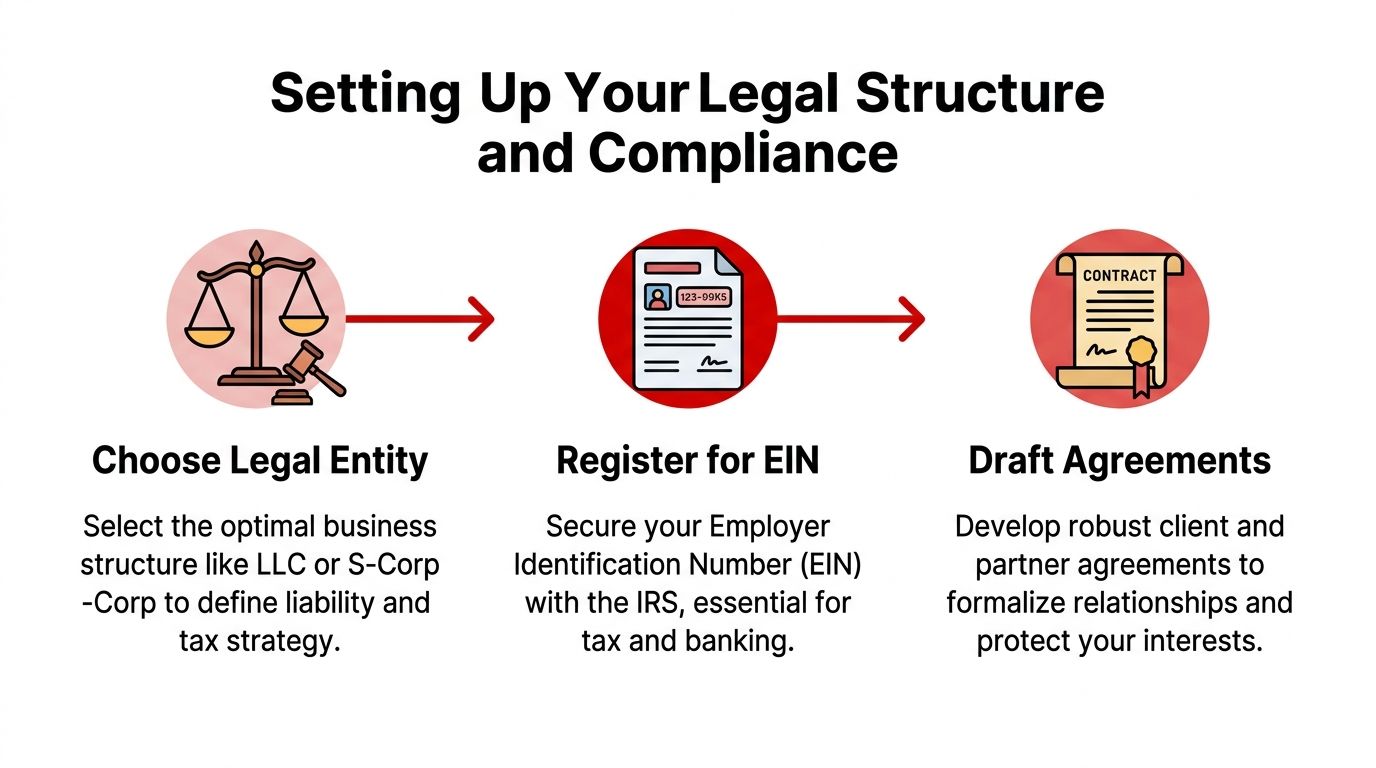
The founder needs a legal entity, an EIN, a business bank account, and signed agreements before active outreach begins. Most new brokers consider an LLC or an S-Corp election depending on tax treatment, owner compensation plans, and administrative preference. The right choice depends on jurisdiction and accounting setup, but delaying the decision usually creates messy paperwork later.
For founders comparing entity options in the UK context, Action Accountants' company formation advice is a useful primer on how limited companies and sole trader structures differ in liability and administration.
Use this setup order:
- Form the entity first: That creates a clean operating shell for agreements, banking, and tax records.
- Get the EIN next: Lenders, banks, and vendors will expect it.
- Open a dedicated bank account: Mixing personal and business money is amateur behavior.
- Draft broker-facing agreements: Client intake forms, disclosure language, partner agreements, and internal process documents should be ready before the first file lands.
Compliance is part of the product
Compliance isn't a side task. In brokerage, it is part of what the client is buying. The client is trusting the firm to handle sensitive financial data and place deals responsibly.
According to this brokerage setup overview, regulated brokerage businesses in the United States, United Kingdom, and India must meet licensing standards through FINRA, the FCA, and SEBI respectively, and operating without the required registration creates legal ineligibility and potential fines. That same source notes that successful startups often allocate 15% to 20% of initial capital to marketing and digital presence, and that the first year is typically focused on learning the operational ropes and building credibility rather than immediate profitability.
That reality matters even for founders pursuing lower-barrier business lending models. The lesson isn't that every beginner needs a heavyweight securities structure. The lesson is simpler. A founder should know exactly what activities the firm will perform, what rules apply in that jurisdiction, what disclosures are required, and what the firm must avoid.
A minimum compliance checklist should include:
- Written process standards: Intake, document handling, partner communication, and file storage.
- Data protection habits: Sensitive borrower records should be handled with discipline.
- Clear client disclosures: The borrower should understand the broker's role and compensation structure.
- Fair-treatment standards: Every broker should study the basics of fair lending practices before accepting applications.
A sloppy broker doesn't just risk chargebacks or disputes. A sloppy broker destroys trust before the business has a chance to grow.
Building Your Lender Network and Pricing Strategy
Most new brokers obsess over getting clients before they build lender coverage. That's backwards. A broker without lender relationships is just collecting frustrated applications.
What to ask every lender partner
The lender network should be built deliberately. The founder needs enough coverage to place straightforward deals, tougher files, and renewals without bouncing clients around blindly.
Every lender conversation should answer these points:
- Approval profile: What credit bands, time in business, revenue profile, and industries fit the box?
- Document requirements: What must be in the file before review starts?
- Speed and communication: How fast does the partner respond, and who owns follow-up?
- Commission structure: What does the broker earn on first funding, renewal, and upsell?
- Decline clarity: Does the lender explain why a file was declined, or does it disappear into silence?
A weak network creates wasted submissions. A tight network creates repeatability.
One practical option for beginners is structured education and a vetted lender ecosystem. Business Lending Blueprint teaches people how to launch a business loan brokerage and work with alternative lending products. It doesn't provide loans.
Commission rates by loan product
According to this breakdown of broker income and commissions, business loan brokers work on pure commission with no salary or hourly pay. That source states that top performers can exceed $500,000 annually, while commission ranges vary by product: 2% to 5% for direct lenders like banks and credit unions, 5% to 10% for alternative lenders offering term loans and SBA products, 8% to 15% for MCA and revenue-based financing, and 10% to 20% for high-risk funders or equipment financing specialists. It also notes recurring commissions of 8% to 15% on renewals and upsells.
That means pricing strategy shouldn't be emotional. It should match product complexity, lender fit, and long-term client value.
| Loan Product | Commission Range |
|---|---|
| Direct lenders such as banks and credit unions | 2% to 5% |
| Alternative lenders offering term loans and SBA products | 5% to 10% |
| Merchant Cash Advance and revenue-based financing | 8% to 15% |
| High-risk funders or equipment financing specialists | 10% to 20% |
| Renewals and upsells | 8% to 15% |
A broker also needs to understand compensation language clearly when discussing referral relationships. For a plain-English explanation of fee terminology, especially in service businesses, this guide that helps define finders fee for salons is a useful reference.
The right pricing strategy doesn't chase the highest percentage on paper. It protects reputation, repeat business, and renewal income.
Acquiring Clients with Referral and Digital Methods
Cold calling still gets talked about because it sounds active. It isn't the smartest starting point for a broker business.
Referral beats cold outreach
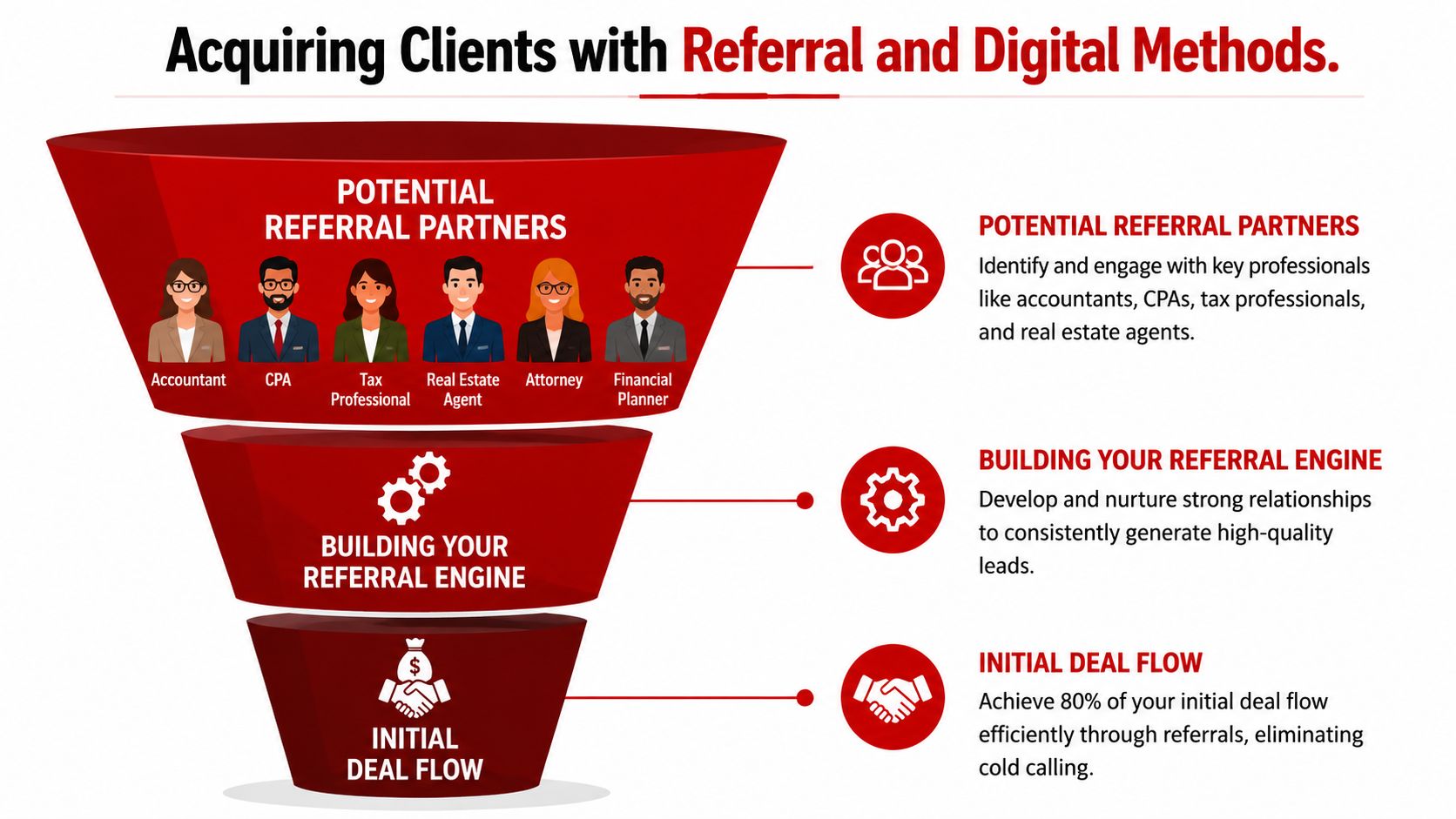
According to recent referral-driven deal flow data, 73% of funded small business deals in 2024–2025 came through referral networks and lender partnerships rather than cold outreach, only 9% of starting-a-broker articles explained referral-driven systems with specific partner criteria, and referral-derived deal volume reached $2.1B in 2024.
That lines up with what works in real brokerage businesses. Warm introductions convert better because trust enters the conversation before the broker does. The borrower arrives with context, and the referring partner has already framed the need.
The best early referral partners are usually people who already hear about funding problems first:
- CPAs and tax professionals: They see cash flow pressure early.
- Credit repair and financial service professionals: They meet business owners who need capital options.
- Real estate and commercial advisors: They encounter timing gaps, expansion plans, and transaction needs.
- Business consultants and agencies: They often know when growth is being blocked by capital.
A referral engine also compounds. One strong accountant can become a consistent source of quality introductions if the broker communicates well and closes files cleanly.
Simple partner scripts that open doors
Referral outreach should be short and useful. Not clever.
A simple email framework works:
“A lot of business owners ask for capital when banks can't move quickly or can't approve the file as submitted. This brokerage helps package and place those deals with alternative lenders. If clients ask about working capital, expansion funding, equipment, or short-term cash flow, this could be a useful resource.”
A simple follow-up call works too:
- Open with the client problem: Business owners often need financing guidance, not just a lender name.
- Explain the role clearly: The broker packages and places deals. The broker doesn't lend directly.
- Set the referral process: Who introduces, what documents are needed, and how updates are shared.
A broker trying to build this channel should also sharpen direct-response systems through content, search visibility, and professional outreach. For founders building inbound channels, this guide on business broker leads is a relevant next step.
Creating Efficient Operations and Deal Flow Scripts
A broker company doesn't fail only because it lacks leads. It also fails when it mishandles files, submits incomplete packages, and creates avoidable friction with borrowers and lenders.

The seven-step review process
According to this operational breakdown for starting a loan business, the biggest technical mistake is submitting incomplete files, which contributes to a 60% to 70% rejection rate for small business loans at traditional banks. The same source lays out a 7-step internal review protocol: Initial Intake → Borrower Interview → Pre-qualification → Document Collection → Internal Review → Lender Placement → Stipulations/Closing. It also states that 80% of early deal flow can come from vetted partners when the broker builds a referral engine rather than relying on cold calling.
That seven-step sequence should be standard operating procedure. Not optional. Not occasional.
A practical version looks like this:
Initial intake
Capture the business need, requested amount, urgency, and basic profile.Borrower interview
Clarify the story behind the request. Why now, what happened, what repayment path exists, and what issues may surface in underwriting.Pre-qualification
Decide whether the file fits likely lending lanes before requesting unnecessary paperwork.Document collection
Gather statements, identification, business records, and supporting items required for the target product.Internal review
Check that the file is complete, current, and consistent.Lender placement
Match the file to the most suitable partner rather than blasting it across the market.Stipulations and closing
Manage conditions, signatures, updates, and borrower communication until funding is complete.
Incomplete files don't just lower approval odds. They tell lenders the broker can't be trusted with better opportunities.
Borrower and partner scripts that keep files moving
Operations improve when scripts remove hesitation.
Use direct borrower language:
- For missing documents: “The file can't move to lender review until the required items are current and complete.”
- For deal positioning: “This request will be placed with the partner most aligned with the file, not with the largest list.”
- For expectation setting: “Approval, terms, and timing depend on the strength of the completed package.”
Use direct partner language:
- For referral partners: “The faster complete files come in, the faster updates and outcomes go back out.”
- For lenders: “This package has been reviewed internally and includes the documents needed for a clean first look.”
The broker who sounds organized usually becomes organized. The broker who “wings it” usually chases missing statements for days.
Conclusion with Launch Checklist and 90-Day Roadmap
A broker company becomes real when the founder stops researching endlessly and starts building a repeatable machine. That machine has five moving parts. The right model, the right legal structure, a lender network, a referral engine, and disciplined file management.
Launch checklist
Use this as the minimum standard before full outreach begins:
- Choose the business model: Introducing broker, white-label, or full-license path.
- Pick the initial niche: Start where existing relationships and borrower pain already overlap.
- Form the entity and get the EIN: Keep banking and records clean from day one.
- Prepare agreements and disclosures: Don't take files casually.
- Build the lender list: Cover core funding scenarios before marketing hard.
- Define commission expectations: Know which products fit the firm's strategy.
- Set referral partner messaging: Make it easy for partners to refer.
- Install the intake and review workflow: Every file should move through the same process.
A practical 90-day roadmap
The first month should focus on setup and clarity. Form the business, finalize the niche, prepare documents, and begin lender conversations. The founder should also write the core referral message and create a simple intake process.
The second month should focus on relationships. Reach out to accountants, consultants, tax professionals, real estate contacts, and other professional partners. The goal is not mass attention. The goal is a small group of quality referral sources who understand exactly what kind of client to send.
The third month should focus on execution. Tighten follow-up, review every file carefully, and track where deals stall. Some founders discover the niche is right but the lender mix is wrong. Others discover the lenders are fine but the referral explanation is muddy. That's normal. The first quarter is where the company gets operational discipline.
A good broker business doesn't begin with hype. It begins with clean structure, focused positioning, and a process that makes partners comfortable sending business repeatedly.
Business Lending Blueprint shows aspiring brokers how to build a profitable lending business, work remotely, and help business owners secure funding through alternative lenders without becoming a lender themselves. Anyone serious about launching should watch the free training at Business Lending Blueprint or schedule a strategy session to get a clearer path from setup to funded deals.