A lot of people looking at the business loan broker space want a niche they can learn quickly, work remotely, and turn into repeatable referrals. Restaurant equipment is one of those niches.
The reason is simple. Restaurants need equipment before they can serve a single customer, and when equipment fails, they can't wait around. That creates steady demand for brokers who know how to structure deals, set expectations, and move files to funding without wasting everyone's time. For an aspiring broker, financing restaurant equipment isn't just a product category. It's a practical entry point into a business built on urgency, referrals, and repeat clients.
Restaurant owners also need more than a generic “apply here” solution. They need someone who understands the difference between financing a full kitchen buildout, replacing a dead cooler, or bundling a POS refresh with smaller operational upgrades. That's where a broker becomes valuable.
Table of Contents
- Your Entry into a Multi-Billion Dollar Market
- Decoding the Core Financing Options for Restaurants
- How to Qualify a Restaurant Client for Funding
- Your Playbook for Structuring and Closing Deals
- Building Your Referral-Based Broker Business
- Start Your Restaurant Financing Business Today
Your Entry into a Multi-Billion Dollar Market
A restaurant concept can look ready on paper and still stall the moment the equipment quotes come in. One quote for cooking, refrigeration, prep, and front-of-house systems can stop an opening cold. That's where a broker steps in.
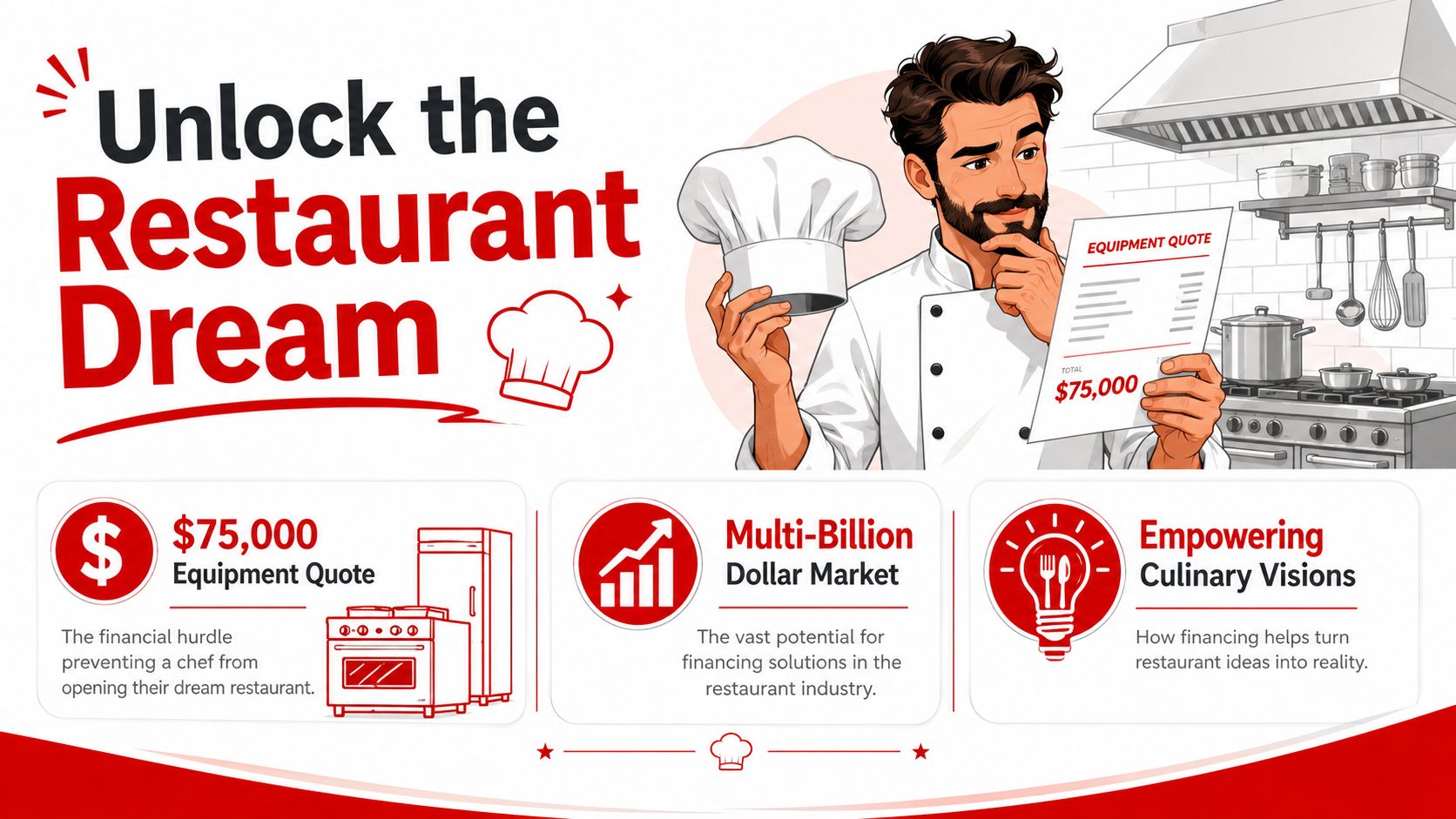
A good broker doesn't just find money. A good broker translates a pile of equipment needs into a fundable transaction that protects the owner's cash for payroll, inventory, and launch expenses. That's why this niche works so well for someone building a home-based brokerage. The need is immediate, the use case is easy to understand, and the value to the client is obvious.
This isn't a small corner of commercial finance. The global restaurant equipment market was valued at USD 4.80 billion in 2025 and is projected to reach USD 11.08 billion by 2036, growing at a 7.9% CAGR, according to the Equipment Leasing and Finance Association industry overview. That matters because equipment financing demand doesn't come only from new openings. It also comes from remodels, replacements, kitchen upgrades, and expansion.
For a new broker, that creates multiple deal paths:
- Startup openings: New operators need full equipment packages.
- Existing operators: Established restaurants replace aging assets and add capacity.
- Operational upgrades: Owners finance technology, service improvements, and phased purchases.
Restaurant owners already work from long checklists before opening. A resource like OrderOut's restaurant startup guide shows just how many moving parts compete for cash at launch. Equipment financing helps ease one of the biggest pressure points on that list.
Practical rule: The broker who can turn an equipment quote into a clear funding strategy becomes useful fast, even if the client has never worked with a broker before.
Decoding the Core Financing Options for Restaurants
A broker who only knows one product will lose deals that should have closed. Restaurant clients don't all need the same structure, even when they're buying similar equipment.
Start with the asset and the urgency
Some equipment makes sense in a straightforward equipment finance agreement. Some fits better in a lease structure. Some projects belong in an SBA-backed package when the deal is larger and the borrower profile supports it. And some urgent needs get solved with faster capital, even if that option isn't the cheapest.
The key is matching the structure to three things:
- How long the equipment will stay useful
- How fast the client needs funding
- How much payment pressure the business can realistically carry
A full kitchen package for a stable operator often calls for a term structure tied to equipment life. A restaurant doing recurring technology replacements may need more flexibility. Recent industry coverage notes that financing has expanded to include POS systems and smaller-ticket upgrades, with some lenders offering funding in as little as 24 hours through this industry overview of restaurant equipment financing trends. That changes the broker's job. It's no longer just about big ovens and refrigeration. It's also about tech-enabled hardware, phased purchases, and mixed baskets of equipment acquired over time.
For broader background on leasing mechanics, this guide on small business equipment leasing is worth reviewing alongside restaurant-specific deal strategy.
Restaurant Equipment Financing Options at a Glance
| Financing Type | Typical Amount | Interest Rate/Factor Rate | Term Length | Best For |
|---|---|---|---|---|
| Equipment financing agreement | Varies by equipment package | Varies by borrower and asset quality | Usually tied to useful life of equipment | Durable kitchen equipment the client wants to own |
| Capital lease | Varies | Depends on structure and credit profile | Multi-year | Clients who want lower upfront cash needs with an ownership path |
| Operating lease | Varies | Depends on lease terms | Shorter or upgrade-oriented terms | Equipment that may be refreshed or replaced sooner |
| SBA-backed equipment structure | Often used for larger equipment-heavy projects | Depends on program and lender | Longer repayment profile | Stronger files, expansion projects, and borrowers wanting lower-cost long-term structure |
| Line of credit or revenue-based structure | Usually smaller, recurring, or urgent needs | Depends on provider and payment mechanics | Flexible or shorter-cycle use | Repeated upgrades, tech refreshes, and timing-sensitive purchases |
| Merchant cash advance | Varies | Higher effective cost is common | Shorter repayment cycle | Emergency replacement when speed matters more than cost |
A new broker doesn't need to memorize product jargon first. It's better to ask: Does this client need ownership, flexibility, speed, or the lowest manageable monthly burden?
Used equipment and tech upgrades need different thinking
Used equipment trips up a lot of new brokers because the client assumes lower purchase price means easier financing. That isn't always true.
Lenders may look harder at age, condition, resale value, and service history on second-hand assets. A used oven from a solid seller can be financeable. A mixed package of older assets with unclear valuation can turn into a problem file. That's why used equipment needs cleaner documentation and stronger vendor support.
Tech upgrades create a different issue. A POS replacement, handheld ordering hardware, and smaller back-of-house systems may not fit the old model of “one large purchase, one fixed loan.” Some restaurants need financing that can keep up with repeated upgrades instead of a single one-time build.
The best product isn't the one with the easiest approval. It's the one the client can still live with six months later.
That's the broker's edge. Not application forwarding. Product judgment.
How to Qualify a Restaurant Client for Funding
Restaurants can be financeable and still be fragile. A broker has to know the difference before sending a deal out.

What lenders are really screening for
Restaurant economics are tight. More than 60% of independent restaurants operate on profit margins below 5%, based on data cited by Crestmont Capital, which also notes that financing often covers 80% to 100% of equipment value and may require a 10% to 20% down payment for startups or weaker credit profiles in some cases, as explained in this used restaurant equipment financing analysis. That's why lenders don't just ask whether the owner wants the equipment. They ask whether the business can absorb the payment when sales dip.
A broker should screen these issues early:
- Business stage: Startup, expansion, or replacement for an existing operator
- Cash flow pattern: Stable deposits beat seasonal volatility with no explanation
- Credit profile: Stronger files get more options, but weaker files may still be workable with the right structure
- Equipment profile: New, used, mixed package, or technology-heavy purchase
- Urgency: Planned purchase versus emergency replacement
Operational discipline matters. Restaurant owners who run tighter systems usually produce cleaner financials and cleaner bank activity. Content on practical restaurant management systems can help brokers understand how serious operators manage labor, inventory, and service consistency, all of which affect fundability indirectly.
Documents that separate real deals from tire-kickers
New brokers waste a lot of time because they mistake interest for readiness. A serious restaurant client should be able to produce a usable file.
A solid qualification package usually includes:
- Recent business bank statements: These show deposit consistency and payment pressure.
- Basic financial reporting: Profit and loss reporting helps explain the cash flow story.
- Vendor quote or equipment list: Lenders need to see what's being purchased.
- Business formation documents: Especially important for newer entities.
- Debt picture: Existing obligations affect approval and payment comfort.
For borrowers with existing debt, reviewing a debt service coverage ratio calculation helps a broker think like a lender before the file is submitted.
Weak files don't usually fail because the client wants too much equipment. They fail because the story and the paperwork don't line up.
A client who says sales are strong but shows erratic deposits, unpaid obligations, or a vague equipment list isn't ready for broad submission. That file needs cleanup first. Good brokers protect lender relationships by filtering that out early.
Your Playbook for Structuring and Closing Deals
Deals close faster when the broker controls the process instead of reacting to it. That means building a repeatable playbook.
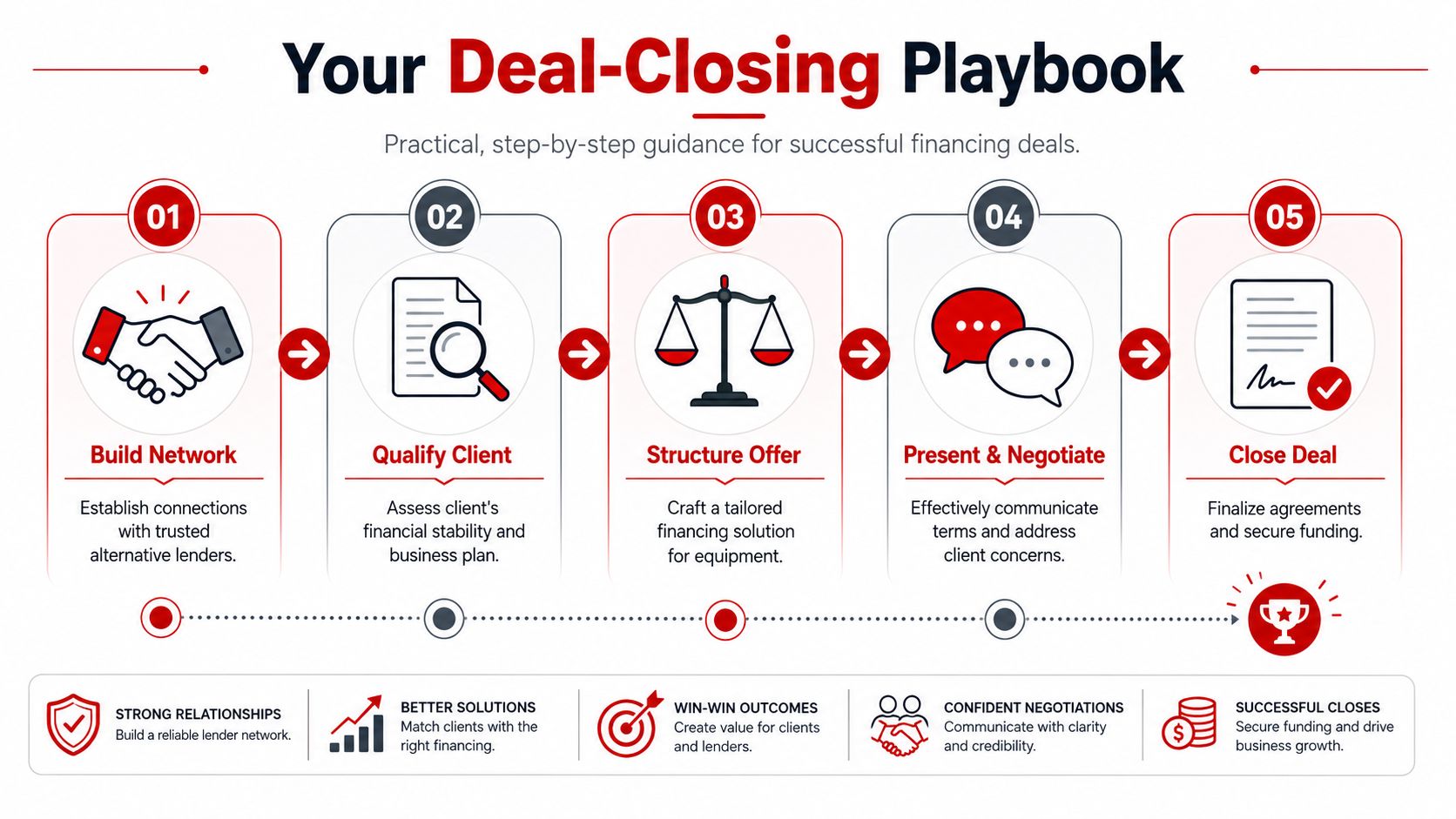
Build the file before sending the deal out
A sloppy submission makes even a decent client look risky. A clean submission makes the underwriter's job easier and gives the borrower a better shot at useful options.
A rigorous proposal should itemize every needed asset, include vendor-verified quotes, and account for side costs such as shipping, installation, and insurance. Lenders are also advised to review the interest rate, origination or processing fees, repayment term, and any prepayment penalty, as outlined in this guide on how to finance restaurant equipment for startups. Red flags can include balloon payments, variable-rate clauses, mandatory insurance, and restrictive covenants.
A practical broker package should include:
A complete equipment schedule
Group assets by station or function. Cooking line, refrigeration, prep, front-of-house, and technology.A source-and-use summary
Show the equipment cost and all related soft costs that affect the true financing need.A short deal narrative
Explain whether this is a startup opening, replacement cycle, remodel, or expansion.A repayment fit check
Don't just ask whether the client can be approved. Ask whether the payments fit the business.
For clients carrying multiple obligations, this resource on what a debt schedule is and how to organize one helps a broker package liabilities cleanly before submission.
Present offers like an advisor, not an order taker
Once offers come in, the broker's job shifts from packaging to interpretation. Many restaurant owners look at monthly payment first. That's understandable, but incomplete.
A lower payment can hide a longer term, higher fees, or a structure that traps the borrower if they want to refinance or pay off early. A broker should walk the client through the trade-offs in plain language.
Use this framework when comparing offers:
- Total borrowing cost: Not just payment size
- Repayment structure: Fixed, variable, or sales-linked
- Ownership outcome: Does the client own the asset at the end
- Restrictions: Insurance, usage terms, reporting requirements, or prepayment conditions
- Timing: Fast funding matters if a kitchen line is down
Underwriting lens: If the offer solves today's equipment problem but creates next quarter's cash crisis, it's the wrong offer.
Good brokers also keep lender communication tight. If an underwriter asks for clarification, respond with direct answers and organized documents. That's one of the fastest ways to build credibility and improve future turnaround times.
Building Your Referral-Based Broker Business
A broker doesn't build a stable business by chasing random one-off deals forever. The true advantage comes from referral channels that keep producing opportunities.
A strong niche helps because referral partners know exactly when to think of the broker. Restaurant equipment financing is especially useful here because the need is easy to spot. An owner is opening, replacing, upgrading, or expanding. Those events trigger financing conversations naturally.
The market is already trained to use financing for equipment. The Equipment Leasing and Finance Association reports that more than 8 in 10 U.S. companies, or 82%, use some form of financing when acquiring equipment, including loans, leases, and lines of credit, excluding credit cards. That makes referral building easier because the broker isn't trying to convince the market that financing exists. The broker is trying to become the person who can manage options others can't.
Who sends the best restaurant equipment referrals
The best partners are usually the ones closest to the purchase decision.
Examples include:
- Equipment sellers and consultants: They see buyers when the financing question is immediate.
- CPAs and advisors: They hear when cash should be preserved instead of drained.
- Commercial service providers: They often know when a restaurant is expanding or replacing key assets.
- Existing clients: An owner who had a clean experience often knows other operators.
The relationship works when the broker becomes reliable, not flashy. Referral partners care about speed, honesty, and clean communication.
How to make referral partners trust the process
Partners don't want updates only when a deal funds. They want confidence that the broker won't mishandle their client.
That means setting expectations early, communicating clearly when a file is weak, and keeping the process professional from first document request to closing. This article on how to manage client expectations is especially relevant for brokers building long-term referral relationships.
A healthy broker business in this niche can produce meaningful commissions on funded deals. The exact amount varies by lender, deal size, and structure. What matters most is that one funded equipment deal can lead to repeat work, vendor relationships, and additional financing needs later. That's how a remote, referral-driven brokerage becomes sustainable.
Start Your Restaurant Financing Business Today
Restaurant equipment financing is a practical niche because it solves a real business problem. Restaurants need equipment to open, operate, and grow. Brokers who understand qualification, structure, and lender presentation can step into that need with a service that clients immediately understand.
The path is clear. Learn the product options. Qualify hard before submitting. Build complete files. Present offers based on business fit, not just approval. Then turn funded deals into referral relationships with people who already serve restaurant owners.
That's why this niche appeals to aspiring entrepreneurs, consultants, sales professionals, and career changers who want a business they can run from home with low overhead. The skill is learnable. The demand is steady. The business model can scale through referrals instead of cold outreach.
The article gives the operating view. The next step is getting the training, lender access, and deal flow systems to apply it consistently. That's where structured guidance matters. Additional theory isn't the primary requirement. What's needed is a process to follow, a vetted network to use, and support when live deals hit real-world friction.
Business Lending Blueprint shows everyday people how to build a business loan brokerage around opportunities like restaurant equipment financing. If the goal is to build a flexible, home-based business that helps owners get funded while creating commission income, the best next step is to watch the free training at Business Lending Blueprint or schedule a strategy session to see how the model works.