
To become a business loan broker, you get to know the main types of business funding, get access to lenders that accept brokers, set up a simple business, and then find business owners who need capital and match each one with a lender that can fund them. You don’t need a finance degree or a sales background to start. Oz Konar started with zero training. He later founded Business Lending Blueprint in 2014.
The hard part is the one nobody writes down: which lender says yes to which file. Working that out on his own took Oz about three years.
The answers below come from Oz: his YouTube training, a live Q&A call, his earlier notes on this page and our FAQ page.
What does a business loan broker actually do?
A business loan broker connects a business that needs money with a company that provides it. Oz puts it in one line:
“Broker is the middle person between the person who needs the money and the person who provides the capital and you make your commission in between by making the connection.” Oz Konar
You’ll also hear the role called a commercial loan broker or a commercial finance broker, since business loans are commercial loans. The work is the same. You talk with the business owner, find out what the money is for and how much they need, and send the file to a lender whose rules fit that deal. The lender’s underwriters decide which files to fund.
A broker isn’t a direct lender. You don’t fund loans with your own capital, and you can’t advertise yourself as a lender. “No, you’re not a lender,” Oz told someone who asked on a live call. “You can’t advertise as a lender.”
Oz sees the job as consulting more than selling. He says he’s big on being a consultant, “not a sales closer guy.” A broker who knows the financing options can help a borrower pick the right one instead of pushing the only product they have.
How Oz Konar became a broker with zero training

Oz didn’t plan on finance. After college he worked at a restaurant as a busboy and picked up a side sales job that paid 100% commission and meant cold calling all day.
Later, in New York City, he sold point-of-sale systems (touch screen computer systems) to restaurants and cafes. Plenty of owners wanted to buy. They just needed financing. Many went to their bank, and weeks went by, sometimes months, while they waited.
Then one owner called back within about three days. He had been funded. The person who arranged it was a broker, and Oz started asking questions and building a relationship with him. The broker suggested a test: send over a couple of customers who needed funding. Oz did, mostly forgot about it, and about a week later the broker called to say Oz had made a commission on a deal.
“That was my first exposure to the alternative lending industry,” Oz says.
He knew nothing about bank lending or non-bank lending, and he had nothing to learn from. “There was no formal training. There weren’t even any YouTube videos talking about the industry.” Who do lenders fund? What files do they accept? Do they take every industry? “It took me like three years solid to have my bearings together to understand the whole industry,” he says. Business Lending Blueprint exists to shorten that learning curve for loan brokers.
Oz tells the full story, and answers the questions people ask most, in this video:

What you need before you start
Experience and education
No finance background is required. On our FAQ page the answer is short: “There is no experience in the Finance industry required.” When people ask Oz if they need a finance degree, he says: “Definitely, you don’t need to have any background at all.”
You don’t need sales experience either. “You don’t have to have sales skills or have a history of selling something,” Oz wrote on this page in 2021. What sells, he says, is you, as a consultant who can give owners their options.
Licensing
When someone on a live call in 2020 asked whether a broker needs a certificate, Oz answered: “No, you don’t need a certificate. You don’t need license or degrees to become a business loan broker.”
Rules are set by each state and they change, so check the current rules in your state before you start taking on clients.
Equipment and running costs
- Hardware: a cell phone or home phone, plus a PC or laptop. No printer or fax.
- Business entity: an LLC isn’t necessary when you start, although it’s recommended. A new broker can work with lenders as a sole proprietor.
- Office and staff: none needed. You can run the business from home.
- Monthly tools: as little as $10 a month to about $160 a month, depending on the tools and services you choose.
Training is a separate cost. Oz is direct about it: “This is a business, there is a financial cost to get involved with our network.” Our FAQ page lists the current enrollment price and payment plans.
How to become a business loan broker in 7 steps
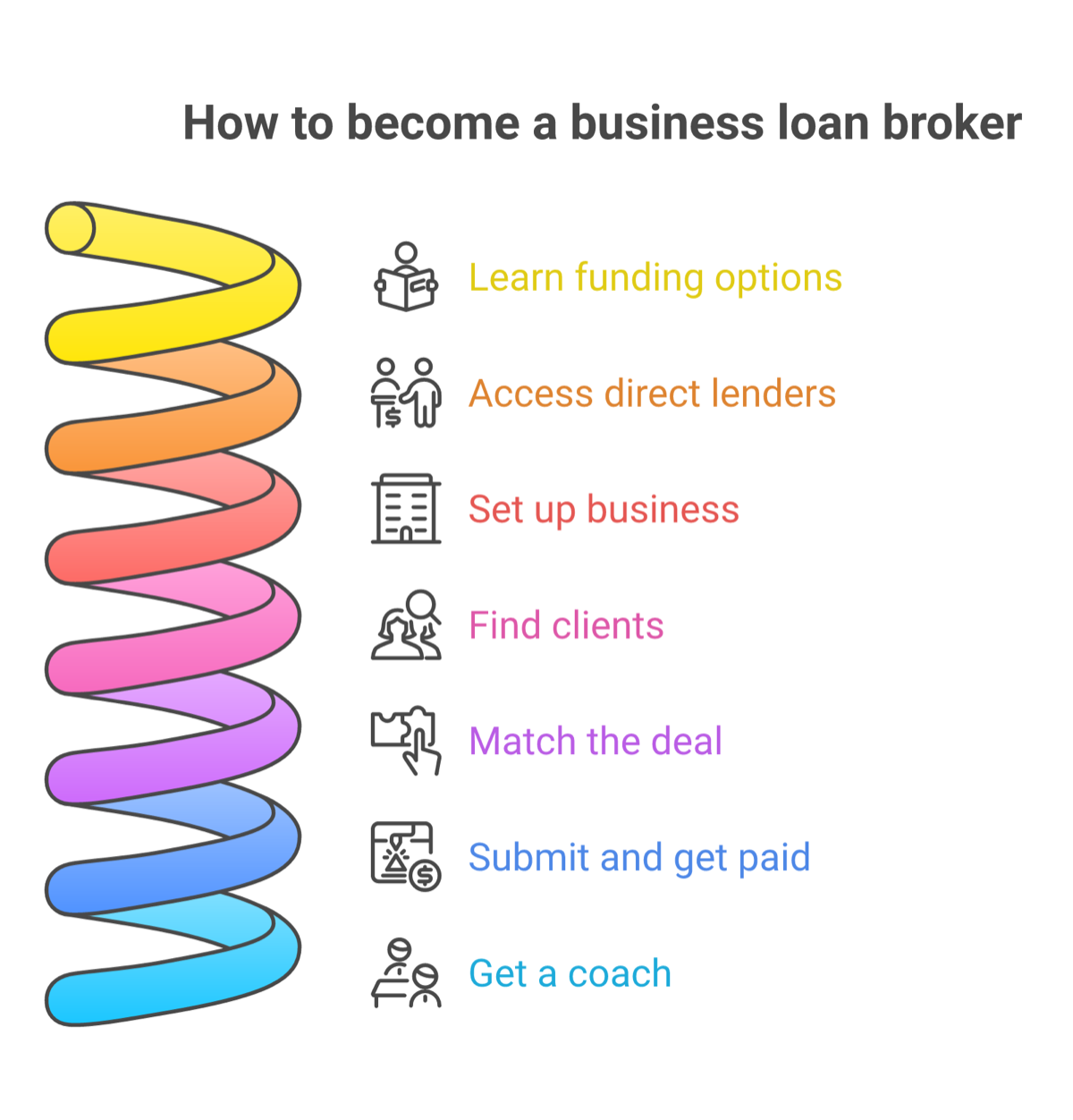
In 2021 Oz wrote down four principles every broker needs on this page: know how to get high-quality leads, have access to the right lending options, know how to get your clients funded and then get yourself paid, and have a coach. The seven steps below put those principles, and the rest of his advice, in the order a new broker usually needs them.
Step 1: Learn the funding options, from SBA loans to equipment financing
When Oz started, merchant cash advance was the only option. Today a broker can match small businesses to many kinds of financing. These are the ones Oz walks through in his training video:
- Startup capital for someone starting a business with no revenue and, in some cases, no tax ID number yet.
- Equipment financing for a business buying equipment. Oz’s example: an owner who needs a new fridge.
- Merchant cash advance, which Oz describes as “urgent emergency type of funding.” A merchant cash advance is repaid from a percentage of the business’s revenue. Oz says an owner who really needs money and doesn’t have good credit can be funded in 24 to 48 hours.
- Real estate funding for a business buying property, such as the building next door.
- SBA funding, the government-backed option for businesses that have been operating for about a year and a half to two years. These are SBA-backed loans made by lenders. Oz notes they come with the longest terms.
- Business lines of credit, which Oz calls one of the least expensive options. “You never want to look for capital when you need it,” he says. “You want to secure it when you don’t need it.”
- Term loans, which Oz groups with SBA funding when he lists the options owners ask about.
Through BLB, members are trained on more than 10 loan products. For a deeper look at two of them, see our guides to the best SBA lenders and equipment leasing.
Step 2: Get access to direct lenders that work with brokers
This is where most people get stuck. “A lot of lenders are not even accepting new brokers, honestly,” Oz says. “And you’re going to be stuck with one product.”
One product means one answer for every borrower, and many borrowers won’t fit it. Oz’s rule is to have as many lending options as you can, because each lender fills a different gap. Credit score, revenue, time in business and loan size all change which lender will say yes.
BLB members don’t have to search for lenders on their own. Members get access to multiple direct lenders for the 10+ products we train on, with a point of contact at each lender.
Step 3: Set up your business
Keep the setup simple:
- Pick a business name. You don’t need an existing tax ID number to get started. Oz told one person on a live call that he could reuse the name of a business he was closing, as long as it wasn’t in a totally different industry.
- Decide on your structure. Start as a sole proprietor or form an LLC.
- Have a bank account ready. Lenders pay brokers by direct deposit into a bank account, not by check.
- Get a website. BLB members receive a website as part of the program.
- Talk to an accountant about taxes. Oz is upfront that this isn’t his area: “I can’t give you accounting or tax advice. I’m not an accountant.”
Step 4: Choose how you’ll find clients
You will talk to business owners. Oz is clear about that. What you don’t have to do is cold call. “If you mean telemarketing, cold calling, no,” he said on a live call. BLB’s training is mostly inbound marketing, with leads generated online through paid and unpaid advertising.
The approaches Oz recommends:
- Start with your existing network. “They don’t need to be a marketing mogul,” he says of people starting out. “They can ask their neighbors and friends and connect them, that’s what the broker is.”
- Build referral relationships with people and companies that already know business owners who need funding.
- Use social media. LinkedIn and Facebook both work. Oz calls LinkedIn “one of them” when asked if it’s the main lead source; which one you use is up to you.
- Use email and other digital marketing to turn readers into clients over time.
- Become the consultant people refer. Trust and a reputation for solving problems bring repeat business and referrals.
- Pick a niche, carefully. Oz says community members work with restaurants, tech startups, construction companies, medical practices and retail stores, among many others. His advice on a live call: “It’s not a matter of choosing one niche. It’s just identifying how to choose it properly.”
What Oz tells brokers to skip: buying aged data and lead lists. Everyone else who bought the list is calling the same people, the information is often outdated, and contacting numbers on a do-not-call list can create legal trouble. Our guide to business loan broker leads goes further.
Step 5: Ask the right questions and match the deal
“We’re training our brokers on understanding the customer’s needs so they can match it to the right funding option,” Oz says. Before you pick a lender, find out:
- What the money is for
- How much they need
- How long they’ve been in business
- Whether they have revenue, and how they take payments (credit cards or invoices)
- Their credit score
- How quickly they need the money
Here’s how those business needs point to a funding option, using the examples Oz gives:
| What the business owner tells you | Funding option to look at |
|---|---|
| Starting a business, no revenue yet | Startup capital |
| Buying equipment, like a new fridge | Equipment financing |
| Needs money urgently, weaker credit, doesn’t want to put up collateral | Merchant cash advance |
| Buying the property next door | Real estate funding |
| Operating for about a year and a half to two years | SBA funding |
| Wants access to capital before they need it | Business line of credit |
Deals that trip up new brokers
Oz used these situations on this page to show why one lender is never enough:
- A business buying equipment. Ask first how long they’ve been in business. That tells you whether their credit can carry the loan or whether you need another way to structure it.
- An owner asking for more than they qualify for. Startups have a cap on how much they can borrow, because lenders want credit history or operating history a startup can’t always show.
- An established business that needs money fast. How quickly they need the funds decides the lender, because not every lender funds as fast.
- A business buying real estate. The purpose decides who can help. Oz’s rule: a property the owner plans to live in isn’t for a business purpose, so it isn’t a deal you can broker.
- An “established” business that is really a startup. If it hasn’t been operating long enough, evaluate it like a startup, whatever the owner calls it.
Step 6: Submit the file and get paid when it funds
You send the deal to the lender that fits, and the lender’s underwriters decide. When the deal funds, the lender pays your commission by direct deposit. If you’d rather not handle every part of the deal yourself, BLB members can bring in our mentors to work the deal with them.
Step 7: Get a coach and keep learning
The last of Oz’s four principles is simple: any good business loan broker has a coach. In BLB, each member gets a coach for weekly one-on-one Zoom calls, along with support by email, Zoom and phone, a private Facebook group and a board of mentors who can work on deals with you.
Four ways to start: Oz’s BLB Cash Flow Quadrant
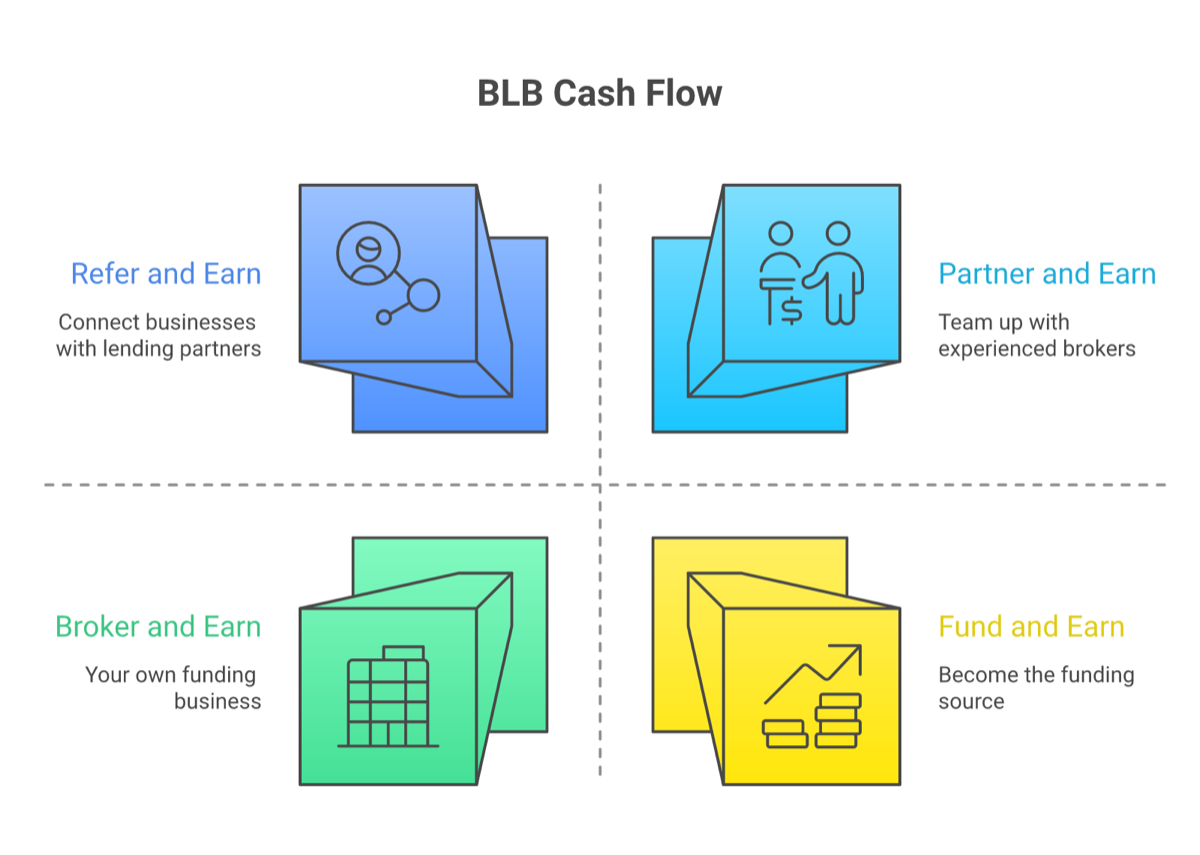
Not everyone starts at the same point. “I created that cash flow quadrant that allows people to start at different points based on where you are,” Oz says. It has four stages:
- Refer and Earn. The easiest way to start. You connect businesses you know with lending partners, often with just a name, email and phone number. Oz says it suits people still working a day job, and it’s where you learn the basics.
- Partner and Earn. You team up with experienced brokers in the community, share resources and funding options, and split larger deals. Oz compares it to “a paid apprenticeship.”
- Broker and Earn. Your own funding business, with the technology and website to run it and direct relationships with lenders.
- Fund and Earn. You become the funding source yourself, as a lender or through syndication.
Oz’s point: it doesn’t have to start with mastering how lending works. Some people only generate leads and connect owners, and that’s still brokering.
How business loan brokers get paid
Broker compensation comes from the lender as a commission when a deal funds. That’s the connection Oz describes: the owner gets capital, the lender gets a funded deal, and the broker is paid for making it happen.
How much a deal pays depends on the product. When people on a live call asked about commission ranges, Oz’s first answer was: “Commission range, it depends.” Some deals can pay more than once, and the businesses you fund often come back for more, so past clients matter. Oz says a real estate deal “can be a repeat commission, if your client keeps getting funding,” and a business line of credit can keep paying a broker each time the client draws on it.
Oz is just as clear about what this isn’t. “I’m not saying that by any means… that you’re guaranteed to make any income. This is not a get rich quick scheme.” Our own position is the same: we don’t guarantee specific earnings.
How much time it takes
Oz asks people about time before anything else. “Minimum an hour a day is good enough, right? You can start slow and ramp it up.” Members who can give it two to three hours a day tend to make faster progress, but we don’t promise a timeline for a first deal.
Consistency matters more than the hours. “The key is consistency,” Oz told a truck driver on a live call. Evenings and weekends count too. Asked whether the business works if your only free time is after 7:00 PM and on weekends, Oz said: “Absolutely, that’s a lot of time.”
You also don’t have to quit your job. “You don’t need to quit your job or make major lifestyle changes,” Oz says.
Mistakes Oz sees new brokers make
- Expecting money to rain. Oz screens for this on purpose: “we need to make sure that you don’t come with the expectation of I’m just going to join and money is going to rain.”
- Working with one lender or one product. You end up forcing every owner into the same option.
- Buying aged leads and data. Costly, crowded and a do-not-call risk.
- Building it one day a week. “I want to build a business on one Saturday” is the line Oz hears. Building a business doesn’t work that way.
- Taking a phone job at a lender “for experience.” Asked if that’s a good way in, Oz said: “Not really, because they’re going to put you through the phones.” You end up dialing six days a week with one or two products and never see how the business works.
Should you learn it on your own or with training?
You can learn this business on your own. Oz says so himself, and his first years prove it. The trade-off is time. It took him about three years to learn which lenders fund which files, and many lenders aren’t accepting new brokers.
That’s the gap our training program fills: it hands you the knowledge Oz had to piece together on his own. Members get the funding education, access to lenders, a coach and the tech platform. If you only want to bring in leads, our in-house team can talk to your customers, close the sale and fund the deal for you. If you’re already a closer and want to learn the whole process, you can run deals yourself.
If you want to compare paths, our pages on commercial loan broker training and commercial lending training cover the training side, and the questions people asked Oz on a live Q&A call are worth a read. You can also see what members say about BLB.
Frequently asked questions
Is it hard to become a business loan broker?
On your own it can take a long time. Oz had no training and needed about three years to understand which lenders fund which files. With training, the business is broken into simple steps: learn the funding options, get lender access, find clients, match deals.
Can you become a business loan broker from home?
Yes. You need a phone and a computer, and no office or staff. Oz started by referring customers he already knew, and BLB’s training is built for a home-based business.
Do you need a license to be a business loan broker?
On a 2020 live call, Oz said you don’t need a license, certificate or degree to become a business loan broker. Rules are set by each state and they change, so check the current rules in your state before you start.
Is the market for business loan brokers saturated?
Oz doesn’t think so. “This market is not saturated at all,” he said on a 2020 live call. In a 2025 video he made the same point about new businesses: “Most of them do not know and will not know how to get it.” His post on whether the MCA industry is saturated goes deeper.
How do business loan brokers get paid?
The lender pays the broker a commission when the deal funds, by direct deposit. The amount depends on the product, and no one can guarantee what you’ll make.
Can I become a business loan broker while keeping my job?
Yes. Oz says you don’t need to quit your job. An hour a day is a workable start, and evenings and weekends count.
Can you become a business loan broker for free?
You can start learning for free. Oz says you can use free content like his videos to learn the business and start on your own. Business Lending Blueprint itself is paid training, and our free training shows how the business works before you decide.
Your next step
There are 36,207,130 small businesses in the United States, according to the SBA Office of Advocacy. “Capital is the most important thing you need to survive,” Oz says, and loan brokers are the people who help owners find it.
Before you decide anything, see how the business works in Oz’s free training. It shows the business model and breaks down what’s included.
Become a small business loan broker
Become blb
I’m ready to become loan broker
I’m curious whether there are any unique difficulties or barriers that recently licenced brokers may encounter. Hearing about some actual experiences or advice for getting through such obstacles would be beneficial.