A familiar pattern plays out every week. A buyer picks a recognizable franchise brand, has decent liquidity, brings a clean resume, and still gets a weak response from a local bank. The borrower assumes the deal is dead. The smart broker knows the deal usually isn't dead. It's just mismatched to the wrong lender, the wrong structure, or the wrong package.
That gap is where franchise business loans become a serious niche. They're large enough to matter, structured enough to underwrite, and repeatable enough to build a referral business around. For an aspiring broker working from home, that matters. One funded franchise deal can create a commission today and a referral source tomorrow through accountants, franchise consultants, attorneys, and operators adding locations later.
Franchise financing also has an advantage many new brokers miss. The borrower usually has a defined use of funds, a documented business model, and a franchisor with operating history. That gives lenders more context than they get with many independent startups. For a broker, more context usually means a cleaner story, a better lender match, and fewer avoidable surprises.
Table of Contents
- The Untapped Goldmine in Franchise Financing
- Your Broker's Guide to Franchise Loan Products
- How to Qualify a Winning Franchise Deal
- Choosing the Right Lender for Your Client
- Packaging the Deal for a Fast Approval
- Earning Commissions and Building a Referral Engine
- Become the Go-To Broker for Franchise Funding
The Untapped Goldmine in Franchise Financing
A buyer wants to open a branded location. The franchisor approves the candidate. Property arrangements are in motion. Equipment quotes are coming in. Then the bank says the file needs more liquidity, more experience, or a different credit box. That's the moment a capable broker stops being optional.

Why franchise deals keep showing up
Franchise business loans aren't a side category. They represent a stable slice of one of the most important small business lending channels in the country. Franchise loans have consistently accounted for 13% of the SBA portfolio's total loan volume, and in the most recent fiscal year before 2026, the SBA 7(a) program funded about $10 billion in franchise loans, according to the Senator Cortez Masto franchise lending report.
That matters for a broker because stable volume creates repeatable opportunity. This isn't a niche built on one-off edge cases. It's a lending lane with ongoing demand from buyers entering proven brands, operators adding units, and borrowers replacing bad financing with better structured capital.
A new broker also doesn't need to invent demand. Franchise buyers are already searching for funding and often start with the wrong channel. That creates room for a broker to step in with education, lender fit, and realistic packaging. For lead generation, that's why a strategy built around business broker leads can convert well when the message focuses on capital access instead of generic loan offers.
Practical rule: A franchise prospect isn't just asking for money. They're asking for a lender path that fits the brand, the borrower, and the timeline.
Why brokers fit this niche so well
Franchise deals reward organization. The borrowers usually have a real target. The franchisor has documents. The lender has known underwriting patterns. That structure helps a remote broker build a home-based business with lower chaos than many generalist funding categories.
There's also a quality advantage. Franchise borrowers tend to come with a clearer story than a pure startup founder with only an idea. A disciplined broker can learn to qualify quickly, package cleanly, and build strong referral relationships with professionals who serve that same buyer profile.
What doesn't work is treating franchise financing like a generic loan request. The strongest brokers don't just collect documents. They diagnose fit, spot gaps early, and send lenders files that are ready to move.
Your Broker's Guide to Franchise Loan Products
The new broker's mistake is assuming franchise business loans are one product. They aren't. A franchise deal may need startup capital, equipment, tenant improvements, working capital, partner buy-in financing, or a mix of uses. Product selection changes the approval odds and the commission path.
How to think about product fit
Franchise loans perform well partly because lenders can underwrite a model with more operating history behind it. Data cited by GoSBA Loans on franchise lending shows franchise loans averaged 9.64% interest, which was 64 basis points lower than non-franchise SBA loans. The same source states a 7.47% default rate for franchise loans and notes that independent startups have a much higher closure rate within five years. For a broker, that's the core pitch to lenders and referral partners. The model often carries more predictability than an unproven concept.
That doesn't mean every franchise file belongs in the same box. Product fit starts with use of proceeds, borrower profile, and whether the deal is startup, acquisition, expansion, or real estate-heavy.
Franchise loan types at a glance
| Loan Type | Best For | Typical Amount | Key Broker Tip |
|---|---|---|---|
| SBA 7(a) | Startup franchise purchases, acquisitions, equipment, working capital, leasehold improvements | Up to $5 million | Use when the deal needs flexibility across several cost categories. |
| CDC/504 | Real estate-heavy franchise projects and major fixed assets | Qualitatively suited for larger owner-occupied projects | Position it when real estate is central and the capital stack needs long-term structure. |
| Conventional bank loan | Strong borrowers with liquidity and a lender-friendly brand | Varies by lender | Reserve this for cleaner files with strong global cash flow and lower perceived risk. |
| Equipment financing | Equipment-heavy concepts | Tied to equipment need | Carve equipment out when it improves the senior loan request. |
| Line of credit | Ongoing working capital after launch or for existing operators | Varies by need | Best as a follow-on relationship product, not a cure for weak startup capitalization. |
A few practical distinctions matter:
- SBA 7(a) is the workhorse. It can cover franchise fees, working capital, fixed assets, and in some structures real estate. New brokers should learn this lane first because it fits many franchise situations.
- CDC/504 works better when the deal centers on property or major long-term assets. It isn't the catch-all startup solution many beginners assume it is.
- Conventional loans can work, but they usually reward stronger borrowers and simpler files.
- Equipment financing can rescue a deal when the main lender doesn't want to carry the full equipment burden.
- Lines of credit are often relationship tools for operators after the location is open and running, not substitutes for proper startup reserves.
A broker who also understands adjacent products becomes more useful over time. Borrowers who don't qualify for a full franchise structure on day one may still need interim funding options, including products discussed in bank statement business loans, depending on the broader business profile.
What works and what doesn't
What works is matching the product to the operational story.
- Good fit: A borrower buying an established franchise with clear startup costs and enough liquidity for equity injection.
- Weak fit: A borrower who wants one loan to cover everything, including an unrealistic cash cushion and personal shortfalls.
- Good fit: Splitting asset classes when that improves lender comfort.
- Weak fit: Forcing a conventional lender onto a startup file just because the borrower wants the cheapest structure.
The broker's job isn't to chase the lowest headline rate first. The broker's job is to get the right deal funded with terms the business can actually carry.
How to Qualify a Winning Franchise Deal
The fastest way to waste weeks is to submit an emotional deal instead of a fundable deal. Franchise buyers are often excited, approved by the brand, and halfway in love with the concept before anyone has tested lender fit. A broker needs a harder filter.
Borrower screens that save time
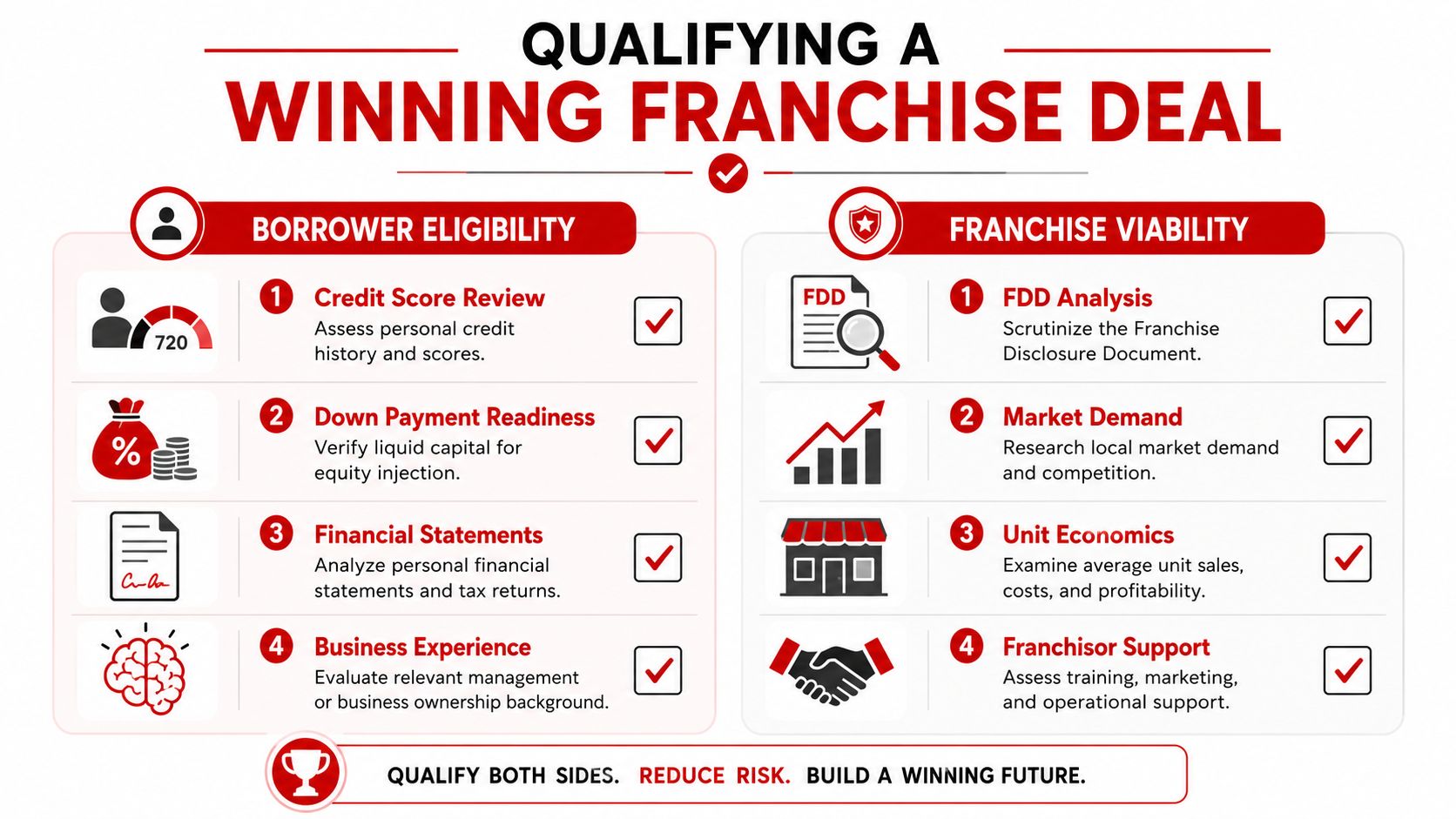
For SBA 7(a) franchise deals, lenders typically want a 680 minimum personal credit score and a 10% to 20% equity injection from non-borrowed funds, according to FBLAKE Bank's franchise loan overview. That same source notes the franchise usually needs to appear in the SBA Franchise Directory for expedited processing.
Those aren't soft guidelines. They're early decision points. If the borrower is below the credit floor, lacks verified liquidity, or is trying to borrow the down payment, the broker should reset expectations immediately.
A clean initial screen should cover:
- Credit readiness: Pull the personal score early and ask about recent issues before a lender does.
- Equity injection: Verify where the injection is coming from and whether the funds are seasoned and documentable.
- Personal financial strength: Review liquidity, contingent obligations, and whether the borrower can support personal expenses during ramp-up.
- Relevant experience: Management, operational oversight, hiring, and prior ownership all help tell a stronger story.
The full underwriting picture overlaps with broader commercial loan requirements, but franchise deals need an extra layer of brand-specific diligence.
Franchise screens that protect approvals
A promising borrower can still get buried by a weak franchise concept, weak unit economics, or incomplete disclosure review. The Franchise Disclosure Document matters because it shows fees, obligations, litigation disclosures, and operating assumptions. It doesn't answer every lending question, but it tells the broker where to probe.
A useful workflow is to review Item 7 for investment ranges, then compare that to the borrower's actual project budget and local market conditions. To speed that research, many brokers use an FDD research platform to compare brand disclosures and avoid relying on a sales conversation alone.
Underwriting lens: A franchise brand can be popular and still be poorly structured for financing in a given market.
Look for these red flags before submission:
- Budget gaps: The project cost is understated relative to buildout, equipment, opening payroll, and reserves.
- Weak local demand story: The borrower likes the brand, but the location strategy is thin.
- Poor borrower-brand fit: The concept needs hands-on operations, while the borrower expects passive ownership.
- Directory issues: The brand's status creates friction for efficient lender review.
Strong brokers qualify both halves of the file. Borrower quality matters. Franchise viability matters just as much.
Choosing the Right Lender for Your Client
A new broker can lose a good franchise deal by sending it to the wrong lender first. Lender selection is a skill. Some lenders want polished, mainstream brands and clean personal profiles. Others will consider more nuanced stories if the cash flow case is strong.
Three lender buckets that matter
The lender market breaks into three broad groups.
Large banks usually like strong borrowers, cleaner documentation, and recognizable franchise systems. They can be a fit for well-capitalized applicants who don't need much underwriting creativity.
Community banks and credit unions may be more relationship-driven. They often work well when the borrower has local ties, deposits, or a compelling local market story.
Alternative and specialty lenders are where many brokers create real value. ADP's discussion of franchise financing notes that many strong non-listed brands can still be funded through lenders using alternative risk models focused on global cash flow, debt service coverage, and brand performance rather than directory status alone.
That last category matters because generic franchise advice often treats directory status like a hard yes-or-no gate. In practice, lender appetite can be more nuanced.
Placement strategy beats volume strategy
Some brokers shotgun files. That usually creates confusion, duplicate pulls, and lender fatigue. Better results come from strategic placement.
A practical framework looks like this:
- Send bankable files to bank lenders: Clean credit, solid liquidity, lender-friendly franchise, realistic timeline.
- Send story-driven files to specialty lenders: Strong cash flow support, good operator profile, but added complexity around the brand or structure.
- Use alternative channels when timing matters: If a borrower must move quickly and understands trade-offs, speed may outweigh headline pricing.
A broker who understands broader capital options also spots side doors when a deal needs temporary support or collateral-driven structure. That's where knowledge of areas like hard money lender for business financing can help frame conversations around bridge scenarios, even if the final franchise loan goes elsewhere.
The best lender match isn't always the most obvious lender. It's the lender most likely to approve the real file sitting on the desk.
Packaging the Deal for a Fast Approval
Underwriters don't fund enthusiasm. They fund documented, coherent stories. Packaging is where a broker turns a stack of borrower files into a lender-ready submission that answers the likely questions before they're asked.
The package underwriters want to see
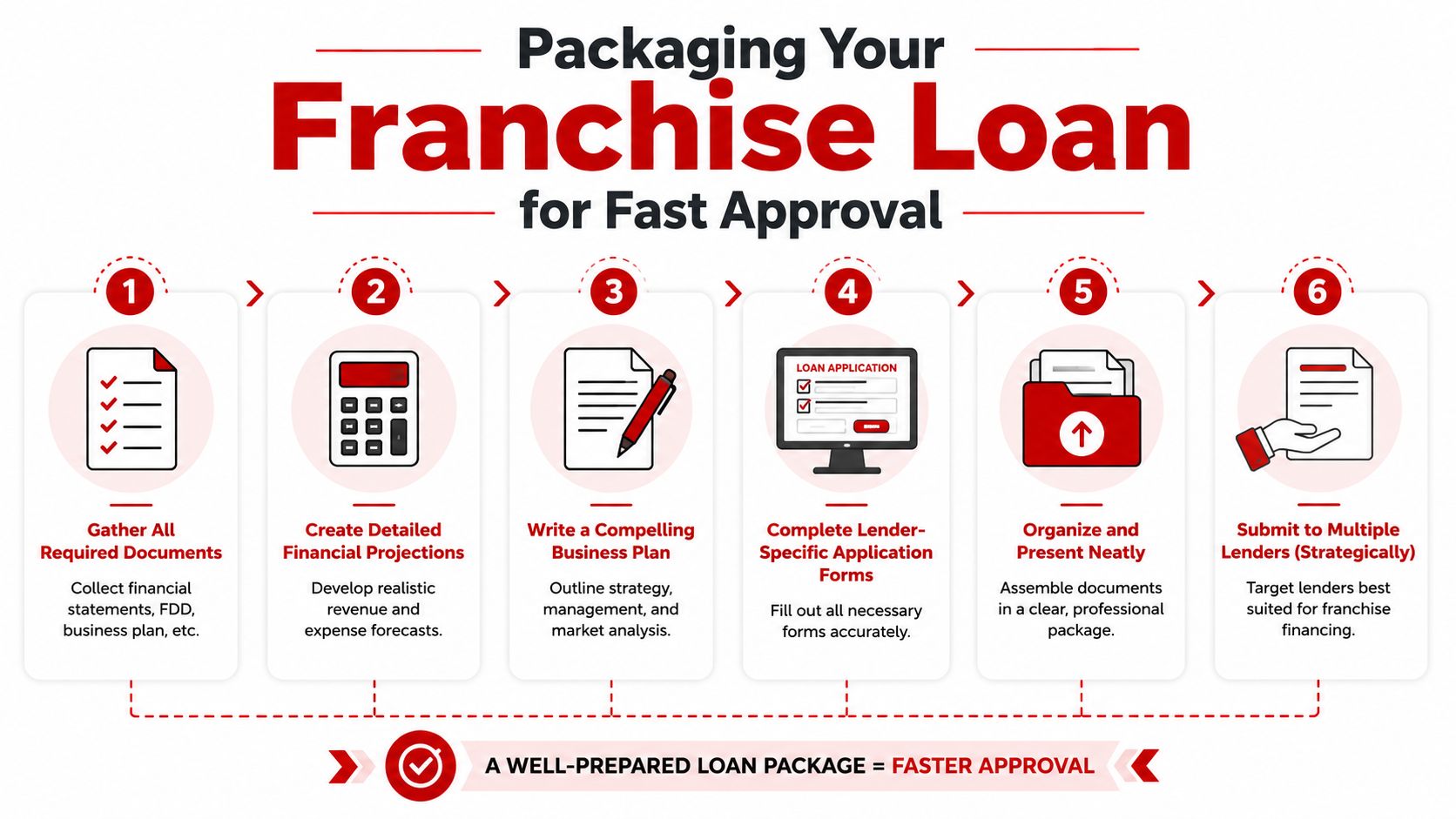
A strong franchise submission is organized around decision-making, not around whatever files the borrower happened to email over. The broker should control the sequence and the narrative.
A dependable package includes:
- Borrower summary with ownership structure, experience, liquidity, and credit profile.
- Project summary showing total uses of funds and where each dollar is going.
- Source breakdown showing injection, loan proceeds, and any seller or landlord participation if relevant.
- Franchise documents including the executed or draft franchise agreement and disclosure materials.
- Financial support such as personal financial statements, tax returns, and any affiliated business information.
- Projections and assumptions tied to real operating expectations, not wishful thinking.
For brokers who want a cleaner process, it helps to study document intake disciplines from adjacent lending workflows. A guide on understanding mortgage document collection is useful because it reinforces a simple truth. Funding slows down when documentation arrives out of order and without context.
The written summary should do real work. It should explain why the borrower fits the concept, how the budget was built, what reserves look like, and where the likely underwriting questions are.
The working capital mistake that kills deals
One of the biggest avoidable failures in franchise business loans is a bad working capital assumption. A common trap is relying too heavily on the FDD's startup estimate. According to the franchise reserve discussion in this video source, lenders often want 6 to 9 months of working capital reserves even when the FDD estimates only 3 months.
That gap changes the whole deal. If the broker packages only the minimum disclosure estimate, the borrower may technically qualify for a loan but still open undercapitalized. That's bad underwriting and bad brokerage.
Use this checklist before submission:
- Stress test the opening period: Ask how long before the location reaches stable operations, not just opening day.
- Rebuild the reserve budget: Include payroll, rent, utilities, marketing, and debt service pressure during ramp-up.
- Document the assumptions: If the reserve request is larger than the franchisor's estimate, explain why.
- Prepare the borrower: Borrowers resist bigger reserve numbers until they understand that underfunding creates a bigger risk than a larger request.
A package gets fast approval when it answers the underwriter's second question before the first email goes out.
Earning Commissions and Building a Referral Engine
Franchise financing is attractive because the work is specialized, the deal sizes can be meaningful, and the referral ecosystem is deep. But the opportunity only becomes a business when the broker understands compensation and builds repeatable deal flow.
How the money works
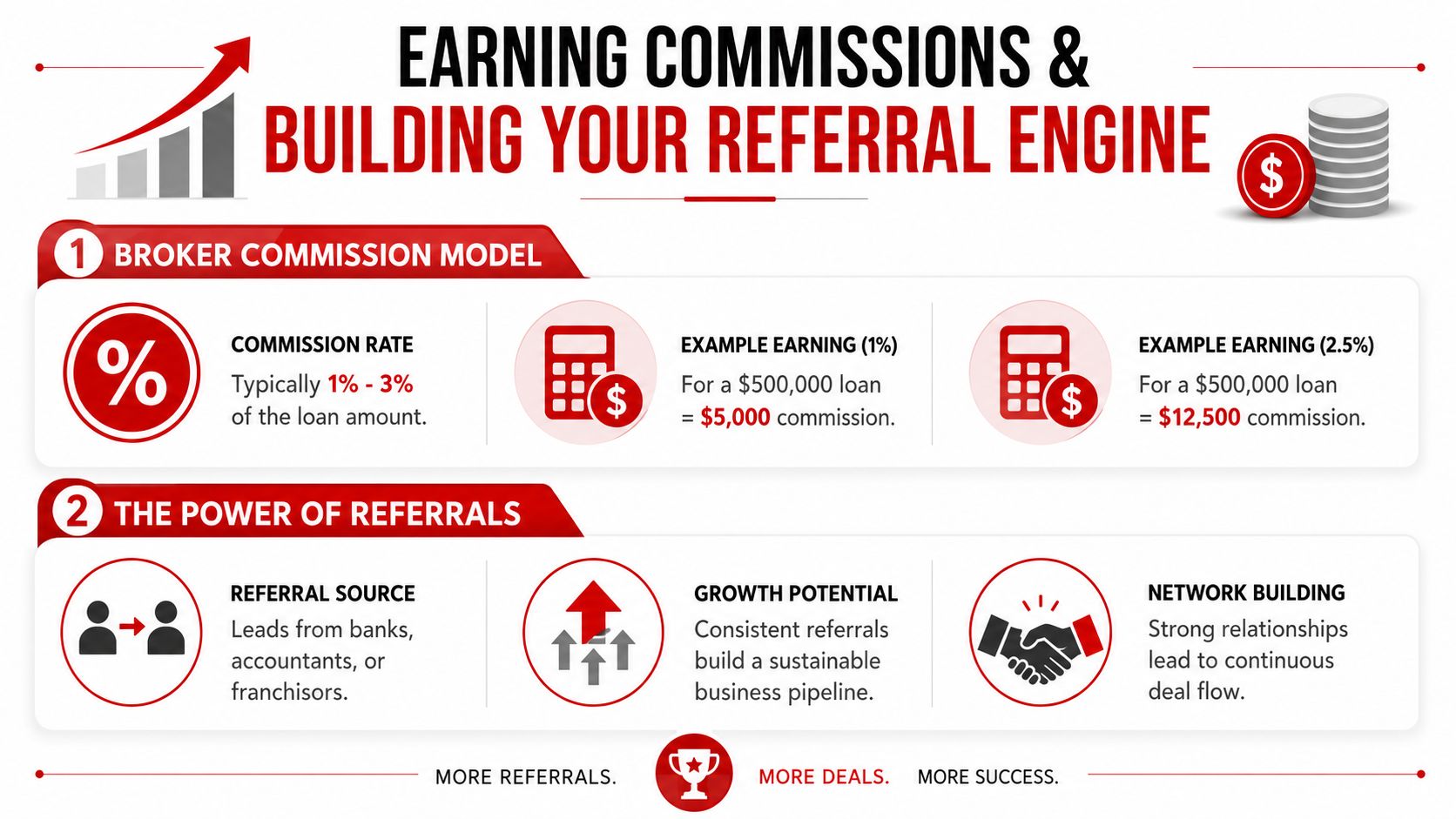
Business loan brokers work on commission. They get paid when a deal funds. According to SendStrike's broker income overview, commissions for alternative lender and SBA products can range from 5% to 10%, and top performers can earn over $500,000 annually by focusing on lender relationships and recurring referrals.
That doesn't mean every franchise deal pays the same way. Compensation depends on product type, lender channel, and whether the broker controls the lender relationship directly. It also means the broker must think in pipeline terms, not one-deal terms.
A useful way to think about franchise finance income:
- Single funded deal: Immediate commission revenue.
- Same operator expansion: Future locations, remodel financing, equipment refreshes, and working capital.
- Professional referrals: Accountants, attorneys, franchise consultants, and local business advisors sending similar borrowers repeatedly.
Where repeat business really comes from
The strongest brokers don't chase strangers forever. They build referral loops around people who already sit near franchise transactions.
Good referral partners usually include:
- Franchise consultants: They talk to buyers before the financing scramble starts.
- Accountants and CPAs: They see liquidity, tax returns, and capital gaps early.
- Attorneys: They're often in the middle of entity setup, review, and closing coordination.
- Commercial real estate professionals: They hear expansion plans before a lender does.
A broker also needs a clear agreement philosophy. Not every referral relationship needs a formal contract, but every serious broker should understand how referral economics are structured. The framework in mastering SaaS referral agreements is useful because it sharpens thinking around expectations, introductions, timing, and payment clarity across referral-driven businesses.
What works in outreach is specificity. “This broker helps franchise buyers get matched with lenders that fit startup, acquisition, and expansion scenarios” is much stronger than “This broker does business loans.”
Relationship lesson: A referral partner sends more deals when the broker protects their reputation, communicates quickly, and declines weak files early.
Become the Go-To Broker for Franchise Funding
Franchise business loans reward discipline more than personality. The broker who understands product fit, screens borrowers accurately, evaluates the franchise itself, chooses lenders carefully, and packages files cleanly will outperform the broker who merely forwards applications.
That's why this niche works so well for serious entrepreneurs who want a home-based, flexible business with room to scale. The work can be done remotely. The overhead is low. The value is real because business owners need access to capital, not just advice. And unlike trend-based online businesses, this niche is tied to a basic commercial need that persists in every market cycle.
The bigger opportunity is that franchise financing teaches the exact habits that create a durable brokerage. Strong intake. Strong lender matching. Strong packaging. Strong referral relationships. Those habits don't only help with one niche. They build a real lending business.
For people coming from sales, banking, consulting, tax, insurance, or entrepreneurship, this can be a practical path into a recession-resistant income model. No hype is needed. The model works when the broker learns the craft, follows a proven process, and keeps building lender and referral relationships over time.
Business Lending Blueprint teaches people how to start and grow a profitable lending business from home by becoming a business loan broker. It doesn't provide loans. It provides training, systems, and mentorship so brokers can help business owners secure funding through alternative lenders while building a flexible, scalable, referral-driven business. To take the next step, watch the free training from Business Lending Blueprint or schedule a strategy session to see how this model can fit current skills and income goals.